Friday, January 30, 2015

A peak into The Sixth Extinction

Classes started this week and I am completely swamped with things that I am doing and supposed to be doing, so instead reading fiction, I am trying to memorize Japanese Hiragana in my "spare time" 'cause that is totally what I should be paying attention to ... thus I don't have a fiction book this week (though Fairest is sitting there giggling at me, waiting for me to pick it up). 

Thus for Book Beginnings on Friday, hosted by Rose City Reader, all I have is a nonfiction work. Here is the start of the Prologue of The Sixth Extinction by Elizabeth Kolbert

Beginnings, it's said, are apt to be shadowy. So it is with this story, which starts with the emergence of a new species maybe two hundred thousand years ago. The species does not yet have a name – nothing does – but it has the capacity to name things. 

As with any young species, this one's position is precarious. Its numbers are small, and its range is restricted to a slice of eastern Africa. Slowly its population grows, but quite possibly then it contracts again – some would claim near fatally – to just a few thousand pairs. 

The members of the species are not particularly swift or strong or fertile. They are, however, singularly resourceful.


For The Friday 56 hosted at Freda's Voice here is a bit from page 56 of The Sixth Extinction ...

The Icelandic Institute of Natural History occupies a new building on a lonely hillside outside Reykjavik. The building has a tilted roof and is designed as a research facility, with no public access, which means that a special appointment is needed to see any of the specimens in the institute's collection. These specimens, as I learned on the day of my own appointment, include: a stuffed tiger, a stuffed kangaroo, and a cabinet full of stuffed birds of paradise. 

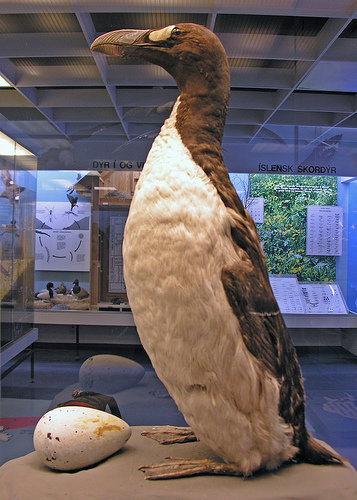
The reason I'd arranged to visit the institution was to see its great auk. Iceland enjoys the dubious distinction of being the bird's last known home, and the specimen I'd come to look at was killed somewhere in the country – no one is sure of the exact spot – in the summer of 1821. The bird's carcass was purchased by a Danish count, Frederik Christian Raben, who had come to Iceland expressly to acquire an auk for his collection (and nearly drowned in the attempt). Raben took the specimen home to his castle, and it remained in private hands until 1971, when it came up for auction in London. The Institute of Natural History solicited donations, and within three days Icelanders contributed the equivalent of ten thousand British pounds to buy the awk back. (One woman I spoke to, who was ten years old at the time, recalled emptying her piggy bank for the effort.) Icelandair provided two free seats for the homecoming, one for the institute's director and the other for the boxed bird. 


 Ohh - this needs pictures !

Icelandic Institute of Natural History


Count Raben's Great Auk with egg (Bird no. 49) at the
Icelandic Natural History Museum in Reykjavík.
From http://www.extinct-website.com/
© Reproduced on Extinct Website by
kind permission of Bruce Aleksander & Dennis Milam


 Have a great weekend !

Wednesday, January 28, 2015

Wondrous Words Wednesday 39

Wondrous Words Wednesday is a weekly meme hosted by Kathy at the Bermuda Onion where you "can share new words that you’ve encountered or spotlight words you love. Feel free to get creative!"

Some neat words ...

From When Oil Peaked by Kenneth Deffeyes (long) (of all places) ...

zymurgy \ˈˌmərjē\
:  a branch of applied chemistry that deals with fermentation processes (as in wine making or brewing)  
Origin: mid 19th century: from Greek zumē 'leaven', on the pattern of metallurgy.


"... a much fuller account of our travel from Scirland to Vystrana, is a window into a time all but forgotten now, in this age of railways, fast ships, and caeligers." 
 
caeligers   

Latin for "heaven supporting" 

Okay, I am having no luck sorting this one out. If someone else has a clue, could you share it in the comments? Clearly this is meant to be a form of mass transport - air ship perhaps? 


"No, you wouldn't ... they are crepuscular hunters, after all. ... Granted, we don't understand very well how it works even with the dragons we've seen..."

crepuscular  \kri-ˈpəs-kyə-lər\

1:  of, relating to, or resembling twilight :  dim <crepuscular light>
2:  occurring or active during twilight <crepuscular insects> <crepuscular activity>  
Origin: : from Latin crepusculum 'twilight' + -ar
First Known Use: 1668 (mid 17th century)


"... as all the gathered villagers ran toward us waving graggers." 
 
graggers  (aka groggers) 

paraphrased from Wikipedia: A ratchet, or noisemaker (or, when used in Judaism, a gragger or grogger (etymologically from Yiddish: גראַגער) or ra'ashan (Hebrew: רעשן‎)), is an orchestral musical instrument played by percussionists. Operating on the principle of the ratchet device, a gearwheel and a stiff board is mounted on a handle, which rotates freely.

Is that what those things are called ?!? They always fell into the generic category of noisemaker for me, upgraded to "give me that thing before lose my mind" at kids parties.  Of course they never had nice wooden ones, just cheap plastic ones that made a terrible racket.


"...in the end, Jacob had to teach me how to abseil, which I was not very good at."

abseil   \ˈab-ˌsāl, -ˌsī(-ə)l\

chiefly British
:  rappel
:  to descend (as from a cliff) by sliding down a rope passed under one thigh, across the body, and over the opposite shoulder or through a special friction device
Origin : German abseilen, from ab down, off + Seil rope
First Known Use: 1941
(Origin of Rappel : French, literally, recall, from Old French rapel, from rapeler to recall, from re- + apeler to appeal, call  
First Known Use: 1944)

You could figure this out from context, but I thought it was cool since I had never heard this term used before. I always just repelled down cliffs.  

I also can't help but think they were doing it wrong in the book. Repelling down a cliff face shouldn't result in a bunch of scrapes and bruises. Jacob should have been feeding her the line for a controlled decent and she should just have been bouncing off the cliff face using her feet. Even beginners pick it up quickly. Odd.

Anyhow, I always thought repelling was the best part of climbing - zipping down the rope is one of the closest things there are to flying. Awesome! 


 Happy Wednesday !


Tuesday, January 27, 2015

AAAAHHHhhhhhh ! ! !

The semester has started. Eeeeek !!!!

 Here - have some babies in tunnels instead ...


Thursday, January 22, 2015

A peak into The Sweetness at the Bottom of the Pie and Hedy's Folly

For this week's Book Beginnings on Friday, hosted by Rose City Reader here is the start of the novel The Sweetness at the Bottom of the Pie by Alan Bradley - the first Flavia de Luce Mystery (I started these and for some reason forgot about them. I need to start reading them all over now!) Just FYI, Flavia is, um, rather precocious ... 

It was as black in the closet as old blood. They had shoved me in and locked the door. I breathed heavily though my nose, fighting desperately to remain calm. I tried counting to ten on every intake of breath, and to eight as I released each one slowly into the darkness. Luckily for me, they had pulled the gag so tightly into my open mouth that my nostrils were left unobstructed, and I was able to draw in one slow lungful after another of the stale, musty air. 

And for my non-fiction choice this week, I have Hedy's Folly: The Life and Breakthrough Inventions of Hedy Lamarr, the Most Beautiful Woman in the World by Richard Rhodes (who was going for an epic length title on a pretty short book) ...

Invention is a strange business. Is it creative, like painting or sculpture? It's certainly original, by definition genuinely new, but it's also and fundamentally practical. Patent law says an idea must be "reduced to practice" to be patentable. That means an idea must be embodied in some new and useful mechanism or process or material. So invention is creative, but not the same way that fine arts are. Usefulness isn't fundamental to a sculpture or a painting. 

Is invention, then, scientific? Many inventions today are explicitly derived from scientific discoveries. The discovery that certain materials, stimulated in a particular way, would emit coherent light–light all of the same wavelength–led to the invention of the laser. The laser was a practical device that embodied the discovery, but wasn't the discovery itself. The distinction is clear even in prescientific times: Fire was the discovery; the fireplace was an invention. That fire hardened clay was a discovery; pottery was an invention. Again, as with fine art, usefulness isn't a requirement for scientific discovery. 


For The Friday 56 hosted at Freda's Voice here is a bit from around page 56 of The Sweetness at the Bottom of the Pie...

Little by little, I had come under her spell. She had talked to me woman-to-woman, and I had succumbed. I felt sorry for her ... really I did. 

"His downfall?" I asked. 

"He made the great mistake of putting his trust in several wretched excuses for boyhood who had wormed themselves into his favor. They pretended great interest in his little stamp collection, and feigned an even greater interest in the collection of Dr. Kissing, the headmaster. In those days, Dr. Kissing was the world's greatest authority on the Penny Black–the world's first postage stamp–in all of it's many variations. The Kissing collection was the envy–and I say that advisedly–of all the world. 

And here is something from page 57 of Hedy's Folly (since page 56 is the last of the previous chapter and completely incoherent on its own) ...


The film Ballet mécanigue premiered in Vienna on 24 September 1924, without George Antheil's music. As late as March 1926, when the film was screened at the London Film Society, a note in the program apologized for the missing soundtrack: "Mr. George Antheil was engaged in the composition of music for this picture but, according to Mr. Léger, this music is not likely to be suitably ready for some time and a jazz accompaniment suggested by Mr. Léger will accordingly be played instead." The music was written by then–but it had grown from a film score into a major composition. "The work had really sprung from previous inspiration," Antheil explained, "derived from its three predecessors: the 'Sonata Sauvage,' the 'Airplane Sonata,' and the 'Mechanisms'–to say nothing of my microscopic sonatina, 'Death of Machines.' 

Okay - I give. There is no way that this is going to make any sense. Unless you either have a degree in film history, modern music or critical theory, this is probably just gibberish.

I mean, come on - this is about a Dadaist post-Cubist art film by the artist Fernand Léger in collaboration with filmmaker Dudley Murphy and with cinematographic input from Man Ray (of all people - just look him up in Wikipedia along with Dada - I am not even going to try). 

 The film is available on YouTube (actually lots of versions) - it's, well, experimental and unique (you might want to make sure you have the volume turned down) ...

BTW - it wasn't actually the movie that was the big deal - it was George Antheil's music - he is our connection to Hedy Lamarr.


Here is an alternative place to view the film ...
http://www.criticalcommons.org/Members/kfortmueller/clips/ballet-mechanique-1924/view
  
 Oh, and Man Ray ... you might recognize this famous photograph called Glass Tears ...

Glass Tears, Man Ray, 1932
  (if you decide to look up more of his artwork be warned some of it is NSFW)


I see no graceful way out of the hole that I have just dug myself (I can't wait to finish the book and try to write a review /sarcasm) so I am just going to say have a lovely weekend.


Tuesday, January 20, 2015

Environmental News 4

Another semester, another oil pipeline bursting ...

Crews work to clean up an oil spill from Bridger Pipeline’s broken pipeline near
Glendive in this aerial view on Monday. Source:LARRY MAYER/Gazette Staff photos (linked)

Oil spills in Montana's Yellowstone River after pipeline leak (Reuters)  
Bridger Pipeline LLC said on Monday it has shut the 42,000 barrel per day Poplar pipeline system after a weekend breach that sent as much as 1,200 barrels of crude oil into the Yellowstone River near Glendive, Montana. 
Oil Spill Contaminates Montana Town’s Water Supply, EPA Says (WSJ)
“The initial results of samples taken from the City of Glendive’s drinking water system indicate the presence of hydrocarbons at elevated levels, and water intakes in the river have been closed,” the EPA said in a statement.

Map from National Pipeline Mapping System - Public Map Viewer

Now I finally find the Montanta DEQ site's office posting ...
http://www.deq.mt.gov/yellowstonespill2015.mcpx

The key points are ...
  • On January 17th Bridger Pipeline LLC detected a pressure drop and shut down flow in the pipeline that crosses the Yellowstone River 9.22 river miles south (upstream) of the City of Glendive.
  • There was a release of crude oil from a 12-inch pipeline.
  • According to company reports, the operator’s aerial patrol plane has confirmed a sheen on the Yellowstone River in open water approximately three fourths-mile downstream and also at the first intake that is 25 miles downstream (north) of Glendive.  Oil sheen has also been found 15 miles north of the intake, near Savage.
  • The company estimates between 300 and 1,200 bbLs (12,600 and 50,400 gallons) have been released. 
    UPDATE: Jan.20, 7:30 a.m. - First Water Test Results Received
    Results from the first water sample taken from the Glendive Municipal Water Treatment Plant has come back and the sample showed an elevated level of volatile organic compounds (VOCs), predominantly benzene. The presence of benzene would account for reports of adverse odor in the local water supply. This test result confirms findings from field samples taken Monday at several locations in the city.
    While the elevated levels are above the level for long-term consumption, the scientists who reviewed the data at the Centers for Disease Control have told the Unified Command that they “do not see that domestic use of this water poses a short term public health hazard.”

Here is the DEQ site map ...

"River is Froze Over Crews Are Investigating."  Froze over? Seriously ? Sheesh.