The Three Body Problem by Cixin Liu, and translated by Ken Liu, is one of the nominees for a best novel Hugo this year.
 To set thing up I think I should explain that the title of the book refers to one of the oldest problems in mathematical physics (i.e. creation of mathematical models to solve problems in physics). [Note - if you are not interested in the science geekery skip to after the video.] The general theory of relativity is one famous and complex example of such a model, but so to is a much simpler equation that most people are familiar with: the Pythagorean theorem, which states that for any right-angled triangle, the square of the length of the hypotenuse, c, (the longest side of a right triangle) equals the sum of the squares of the lengths of the other two sides (a and b).
a2 + b2 = c2
These kinds of models are used all the time in the modern world. Technically, however, the three body problem has never been solved - i.e. no one has found a general equation that can be used to successfully predict the position of the bodies in space at some time in the future given every possible initial set of conditions. This is because the motion of bodies is chaotic and highly sensitive to initial conditions (even a very slight difference in positioning at the beginning can result in wildly different behavior as the system progresses in time).
Up until a couple of years ago there were just three families of special solutions - ones that only apply given a particular initial state: The Lagrange-Euler solutions, where equally spaced bodies go around in a circle (technically a conic section) like horses on a merry-go-round, the figure-eight family which describes three objects chasing each other in a figure eight shape, and the Broucke-Hénon solution where one of the bodies orbits inside a space that the other two bodies zip back and forth through (sorry, this one is hard to describe). In 2013, physicists Milovan Šuvakov and Veljko Dmitrašinović found thirteen new families of solutions, which is exciting for the field but pretty opaque for the rest of the world, and it is now pretty much accepted that there is no general solution to this problem. Instead this is part of the beginnings of chaos theory.
This video is Three-body problem 3D from Daniel Piker
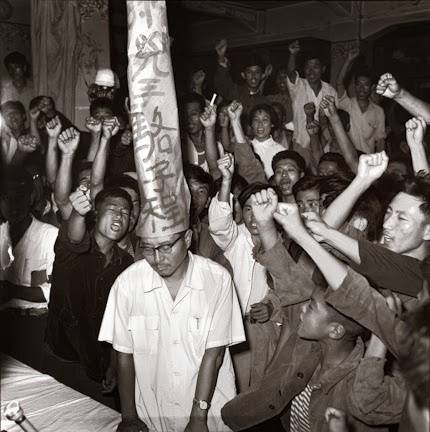
So, now that you know what the title means, you have a better idea of what the story is going to contain. The book starts abruptly with some horrific events set in the background of the Chinese Cultural Revolution and, as it is portrayed in the book, it is pretty overwhelming.
Here are the first couple paragraphs for Book Beginnings on Friday, hosted by Rose City Reader, (note shortly after this bit the story gets into some pretty graphic violence so this book will definitely not be to everyone's taste) ...
1
The Madness Years
China, 1967
The Red Union had been attacking the headquarters of the April Twenty-eighth Brigade for two days. Their red flags fluttered restlessly around the brigade building like flames yearning for firewood.
The Red Union commander was anxious, though not because of the defenders he faced. The more than two hundred Red Guards of the April Twenty-eighth Brigade were mere greenhorns compared with the veteran Red Guards of the Red Union, which was formed at the start of the Great Proletarian Cultural Revolution in early 1966. The Red Union had been tempered by the tumultuous experience of revolutionary tours around the country and seeing Chairman Mao in the great rallies in Tiananmen Square.
But the commander was afraid of the dozen or so iron stoves inside the building, filled with explosives and connected to each other by electric detonators. He couldn’t see them, but he could feel their presence like iron sensing the pull of a nearby magnet. If a defender flipped the switch, revolutionaries and counter-revolutionaries alike would all die in one giant ball of fire.
These events set the stage for what is to follow and the story jumps back and forth in time, moving forward from the events in the Cultural Revolution, and also playing out some of the results in a timeline that is generally now (i.e. the 2010's). The POV shifts from the main character in the earlier time line, Ye Wenjie, to Wang Maio in the present time. It also floats around untethered sometimes, which can get annoying.
To give you a taste of the now timeline (and for The Friday 56 hosted at Freda's Voice) here is a bit from page 56 of the hardback ...
Shi looked around but couldn't find an ashtray. In the end, he dropped the cigarette into a teacup. He raised his hand, and before Chang could even acknowledge him, he spoke loudly. "General, I have a request which I've made before: I want information parity."
General Chang lifted his head. "There has never been a military operation in which there was information parity. I have to apologize to all the scholars, but we cannot give you any more background."
"We are not the same as the eggheads," Shi said. "The police have been part of the Battle Command Center from the start. But even now, we still don't know what this is all about. You continue to push the police out. You learn from us what you need about our techniques, and then you send us away one by one."
Several other police officers in attendance whispered to Shi to shut up. It surprised Wang that Shi dared to speak in this manner to a man of Chang's rank. But Chang's response surprised him even more.
This is roughly were I started having a problem (one of several that developed for me). Non-spoiler version - I don't know any physicists who would be that freaked out that the universe didn't behave in ways that they expected. For the people I know, that would actually be the equivalent of a shot of adrenaline. I know several people who are actually rather bummed out that nothing really strange has happened in the Large Hadron Collider at CERN. The overall behavior and actions of the people in the story just didn't ring true. Yes - I know that there are cultural differences but when a main character seems to just completely forget about the existence of their wife and child, um, nope that doesn't feel right at all.
As I read, this became a general problem for me - none of the characters felt like real people. They are all more like stand-ins for a "concept." Also - I am a scientist. I work with all sorts of natural scientists and seriously - this seemed to be written by someone who has no idea how science actually works. Almost nothing is straightforward and during research, you spend most of you time finding out that whatever it is you are trying to do isn't working, or at least isn't working the way you expected it to. Even at the applied end things usually don't go as planned - you can just ask any scientist who works in an applied field about the "scale up problem." The assumption that you can "stop" the progress of science the way it is discussed in the book is pretty weird. (Yes, I know we get an explanation at the end of the book - well as far as I am concerned, that just leads to a whole new set problems with the story.)
Oh - side note - can we please get over Einstein and Hawking! For Pete's sake - there are other theoretical physicists in the world - certainly people more relevant to where the story seems to be going - how about Mather and Smoot? Or Makoto Kobayashi and Toshihide Maskawa? Can we namecheck some new people here? I did find that further into the book more scientists are name checked, but it still didn't flow.
I also started having more and more problems with the fact that the POV character would think something that in the timeline of the story they didn't know. This most often happened with Wang - who is the "witness" character - the person in the story who has just enough "special" knowledge that it almost seems to make sense that they get hauled around everywhere to witness all the important actions in the story.
Before I go into spoilers, to sum up ...
When I started this book, I was really looking forward to it. I actually had it in my wish list at Amazon months ago because it sounded so cool. Now that I have finished it, I am really disappointed. With all the hype about how deep, insightful, and exciting the book is, I have been left wondering if I read the same book. It wasn't all bad I guess, but for me it definitely didn't even remotely live up to the hype and I honestly don't know if I will ever bother to pick up the next book to see what happens with the human race. As it is presented in the book, you kind of have to wonder if anyone is worth saving.
This story also contains what quite possibly might be the single stupidest sentence that I have read in years (and I grade undergraduate term papers).
The ETO concluded that the common people did not seem to have the comprehensive and deep understanding of the highly educated about the dark side of humanity.
There are so many things wrong with this that I can't even cope with all of it. All I can invite you to do is contemplate the world as it is now and think about how utterly out of touch and offensive that sentence is. (Yes - this is played straight in the story.)
Spoilers Ahead ...
I was going to do a more in-depth discussion of the notes I was taking in the margins of the book about the science and what I thought of it, but I got towards the end of the book, these notes pretty much have completely devolved into "WTH!" and "this doesn't make sense!" or some variation thereof. I ended the book stuck in "This is ridiculous" land and have realized it didn't matter about the previous stuff that I had planned to discuss. The action at the end of the book made everything that came before pretty pointless. If the Trisolarian could do that why in the heck do they need to invade another world? or worry about a handful of Earth scientists? They could literally do anything at this point. They could build their own damn stable world. This just doesn't make any sense. Why use their technology to do something so ...so ... wasteful, if nothing else.
If you are going to use hand-waving science gibberish, you might as well start with gibberish so that it isn't so jarring when you descend into it. I would have turned off my brain much sooner in the book and not have gotten nearly as annoyed.
I completely lost my suspension of disbelief concerning the Trisolarians by the end of the book. They all apparently live on the same side of the planet too, since they can all gather around to stand and stare at various things. Given the conditions expressed, I don't see how any civilization could develop on that planet (which isn't even a three body problem - it is at minimum a four body problem - but then I guess it is really irrelevant how Alpha Centari is really structured, isn't it.) With how horrible life is, with unnecessary Trisolarians being forcibly dehydrated and burned - why are ordinary citizens supporting this massive project!?! What will they gain? No such thing as revolution there I guess.
Still, I have some things that I want to pull out of my notes because they annoyed me so much, sorry but this is going to turn all rambling and disordered now ...
I think that the game was pretty ill-conceived. The book kept describing it as sophisticated and deep, but none of the actual activity in the game was that convincing. And you would be very hard pressed to convince me that an internet based virtual game like Three Body wouldn't immediately have an infestation of hackers trying to crack it. I wasn't even convinced about Wang wanting to keep going back into the game. I have "drugs?" scrawled after it a few times because psycotropic drugs being administered through the V-suit were the only reason I could think of that anyone would keep going back into that "game." I mean, the concept as described makes sense (and has been used before), but the actual execution got increasingly silly.
I am also not at all cool with a significant portion of the plot requiring that there be a massive, coordinated, secret organization of sociopaths on Earth. And on Trisolaris. In fact, pretty much everyone is awful on both a small, personal level, and on the grand level of whatever horrifying philosophy they purport to believe in. Is the message that intelligent life sucks? (Is there any other life on Trisolaris?)
How do you destroy human civilization and not destroy the rest of life on Earth as well? Does not compute! What makes any of the ETO think that 'their Lord' would be any better stewards of Earth's ecosystems?
The book makes this huge deal out of Ye sending that test message to "bounce" off of a solar layer (the "energy mirrors"), even suggesting that the event had been recreated in history books - "No matter how historians and writers later tried to portray the scene, the reality at the time was completely prosaic." And it didn't matter! The Trisolarian picked up the original broadcasts from Red Coast. In fact, that signal she sent would, at that point, actually be the only thing that the Trisolarians needed in order to find Earth, right ? They didn't even need her "traitors" transmission. Massive continuity error here.
The implicit assumption that all civilizations will follow exactly the same pattern in terms of "development' and have the same technical benchmarks - I am not buying that at all.
Soooo - you unfold a proton in whatever number of dimensions to make a big surface area with no depth and make circuits on what exactly? This whole bit is just too nonsensical for me. Like - it has the mass of a single proton but when push it there is air resistance? Against what exactly? Just ARGH! No! If you wanted magic gibberish you should have started there !
***Divide by CUCUMBER error!!! ****
Just how many high energy particle accelerators does the author think are on the Earth? Seems to have woefully underestimated this. Oh - I see - the book claims that the sophons can be everywhere at once. So why should they just be used to mess up some particle physics experiments and scare selected scientists? That's just dumb.
I give - this just does not make any sense anymore. The book started out so promising and has dissolved into a a puddle of rainbow color goo. Now my problem is - does this book go above No Award ? 'cause I have read many better books from the qualifying time period for the Hugo. Given the rules I have set for myself concerning use of No Award, this is a borderline case that is causing me trouble.
SO. TOTALLY. DISAPPOINTED.
To give you a taste of the now timeline (and for The Friday 56 hosted at Freda's Voice) here is a bit from page 56 of the hardback ...
Shi looked around but couldn't find an ashtray. In the end, he dropped the cigarette into a teacup. He raised his hand, and before Chang could even acknowledge him, he spoke loudly. "General, I have a request which I've made before: I want information parity."
General Chang lifted his head. "There has never been a military operation in which there was information parity. I have to apologize to all the scholars, but we cannot give you any more background."
"We are not the same as the eggheads," Shi said. "The police have been part of the Battle Command Center from the start. But even now, we still don't know what this is all about. You continue to push the police out. You learn from us what you need about our techniques, and then you send us away one by one."
Several other police officers in attendance whispered to Shi to shut up. It surprised Wang that Shi dared to speak in this manner to a man of Chang's rank. But Chang's response surprised him even more.
This is roughly were I started having a problem (one of several that developed for me). Non-spoiler version - I don't know any physicists who would be that freaked out that the universe didn't behave in ways that they expected. For the people I know, that would actually be the equivalent of a shot of adrenaline. I know several people who are actually rather bummed out that nothing really strange has happened in the Large Hadron Collider at CERN. The overall behavior and actions of the people in the story just didn't ring true. Yes - I know that there are cultural differences but when a main character seems to just completely forget about the existence of their wife and child, um, nope that doesn't feel right at all.
As I read, this became a general problem for me - none of the characters felt like real people. They are all more like stand-ins for a "concept." Also - I am a scientist. I work with all sorts of natural scientists and seriously - this seemed to be written by someone who has no idea how science actually works. Almost nothing is straightforward and during research, you spend most of you time finding out that whatever it is you are trying to do isn't working, or at least isn't working the way you expected it to. Even at the applied end things usually don't go as planned - you can just ask any scientist who works in an applied field about the "scale up problem." The assumption that you can "stop" the progress of science the way it is discussed in the book is pretty weird. (Yes, I know we get an explanation at the end of the book - well as far as I am concerned, that just leads to a whole new set problems with the story.)
Oh - side note - can we please get over Einstein and Hawking! For Pete's sake - there are other theoretical physicists in the world - certainly people more relevant to where the story seems to be going - how about Mather and Smoot? Or Makoto Kobayashi and Toshihide Maskawa? Can we namecheck some new people here? I did find that further into the book more scientists are name checked, but it still didn't flow.
I also started having more and more problems with the fact that the POV character would think something that in the timeline of the story they didn't know. This most often happened with Wang - who is the "witness" character - the person in the story who has just enough "special" knowledge that it almost seems to make sense that they get hauled around everywhere to witness all the important actions in the story.
Before I go into spoilers, to sum up ...
When I started this book, I was really looking forward to it. I actually had it in my wish list at Amazon months ago because it sounded so cool. Now that I have finished it, I am really disappointed. With all the hype about how deep, insightful, and exciting the book is, I have been left wondering if I read the same book. It wasn't all bad I guess, but for me it definitely didn't even remotely live up to the hype and I honestly don't know if I will ever bother to pick up the next book to see what happens with the human race. As it is presented in the book, you kind of have to wonder if anyone is worth saving.
This story also contains what quite possibly might be the single stupidest sentence that I have read in years (and I grade undergraduate term papers).
The ETO concluded that the common people did not seem to have the comprehensive and deep understanding of the highly educated about the dark side of humanity.
There are so many things wrong with this that I can't even cope with all of it. All I can invite you to do is contemplate the world as it is now and think about how utterly out of touch and offensive that sentence is. (Yes - this is played straight in the story.)
Spoilers Ahead ...
I was going to do a more in-depth discussion of the notes I was taking in the margins of the book about the science and what I thought of it, but I got towards the end of the book, these notes pretty much have completely devolved into "WTH!" and "this doesn't make sense!" or some variation thereof. I ended the book stuck in "This is ridiculous" land and have realized it didn't matter about the previous stuff that I had planned to discuss. The action at the end of the book made everything that came before pretty pointless. If the Trisolarian could do that why in the heck do they need to invade another world? or worry about a handful of Earth scientists? They could literally do anything at this point. They could build their own damn stable world. This just doesn't make any sense. Why use their technology to do something so ...so ... wasteful, if nothing else.
If you are going to use hand-waving science gibberish, you might as well start with gibberish so that it isn't so jarring when you descend into it. I would have turned off my brain much sooner in the book and not have gotten nearly as annoyed.
I completely lost my suspension of disbelief concerning the Trisolarians by the end of the book. They all apparently live on the same side of the planet too, since they can all gather around to stand and stare at various things. Given the conditions expressed, I don't see how any civilization could develop on that planet (which isn't even a three body problem - it is at minimum a four body problem - but then I guess it is really irrelevant how Alpha Centari is really structured, isn't it.) With how horrible life is, with unnecessary Trisolarians being forcibly dehydrated and burned - why are ordinary citizens supporting this massive project!?! What will they gain? No such thing as revolution there I guess.
Still, I have some things that I want to pull out of my notes because they annoyed me so much, sorry but this is going to turn all rambling and disordered now ...
I think that the game was pretty ill-conceived. The book kept describing it as sophisticated and deep, but none of the actual activity in the game was that convincing. And you would be very hard pressed to convince me that an internet based virtual game like Three Body wouldn't immediately have an infestation of hackers trying to crack it. I wasn't even convinced about Wang wanting to keep going back into the game. I have "drugs?" scrawled after it a few times because psycotropic drugs being administered through the V-suit were the only reason I could think of that anyone would keep going back into that "game." I mean, the concept as described makes sense (and has been used before), but the actual execution got increasingly silly.
I am also not at all cool with a significant portion of the plot requiring that there be a massive, coordinated, secret organization of sociopaths on Earth. And on Trisolaris. In fact, pretty much everyone is awful on both a small, personal level, and on the grand level of whatever horrifying philosophy they purport to believe in. Is the message that intelligent life sucks? (Is there any other life on Trisolaris?)
How do you destroy human civilization and not destroy the rest of life on Earth as well? Does not compute! What makes any of the ETO think that 'their Lord' would be any better stewards of Earth's ecosystems?
The book makes this huge deal out of Ye sending that test message to "bounce" off of a solar layer (the "energy mirrors"), even suggesting that the event had been recreated in history books - "No matter how historians and writers later tried to portray the scene, the reality at the time was completely prosaic." And it didn't matter! The Trisolarian picked up the original broadcasts from Red Coast. In fact, that signal she sent would, at that point, actually be the only thing that the Trisolarians needed in order to find Earth, right ? They didn't even need her "traitors" transmission. Massive continuity error here.
The implicit assumption that all civilizations will follow exactly the same pattern in terms of "development' and have the same technical benchmarks - I am not buying that at all.
Soooo - you unfold a proton in whatever number of dimensions to make a big surface area with no depth and make circuits on what exactly? This whole bit is just too nonsensical for me. Like - it has the mass of a single proton but when push it there is air resistance? Against what exactly? Just ARGH! No! If you wanted magic gibberish you should have started there !
***Divide by CUCUMBER error!!! ****
Just how many high energy particle accelerators does the author think are on the Earth? Seems to have woefully underestimated this. Oh - I see - the book claims that the sophons can be everywhere at once. So why should they just be used to mess up some particle physics experiments and scare selected scientists? That's just dumb.
I give - this just does not make any sense anymore. The book started out so promising and has dissolved into a a puddle of rainbow color goo. Now my problem is - does this book go above No Award ? 'cause I have read many better books from the qualifying time period for the Hugo. Given the rules I have set for myself concerning use of No Award, this is a borderline case that is causing me trouble.
SO. TOTALLY. DISAPPOINTED.