Friday, October 3, 2014

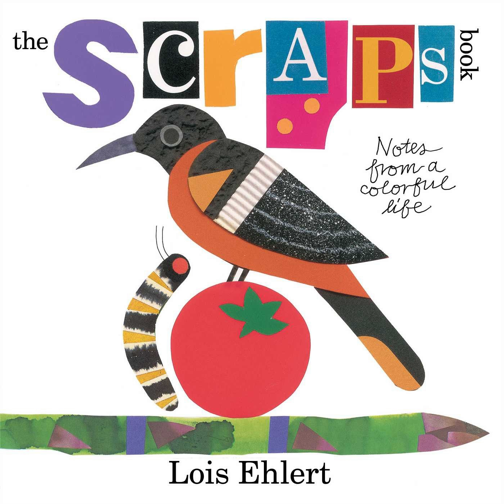
The Scraps Book: Notes from a Colorful Life by Lois Ehlert

The Scraps Book: Notes from a Colorful Life
by Lois Ehlert

Format: hardback

Publisher: Beach Lane Books
Copyright: 2014
Pages:  72

Genre: Artists biography/worklife
Source: library

Summary from Amazon:
The renowned Caldecott Honoree and illustrator of Chicka Chicka Boom Boom provides a moving, intimate, and inspiring inside look at her colorful picture book career.

Lois Ehlert always knew she was an artist. Her parents encouraged her from a young age by teaching her how to sew and saw wood and pound nails, and by giving her colorful art supplies. They even gave her a special spot to work that was all her own.


Today, many years and many books later, Lois takes readers and aspiring artists on a delightful behind-the-scenes tour of her books and her book-making process. Part fascinating retrospective, part moving testament to the value of following your dreams, this richly illustrated picture book is sure to inspire children and adults alike to explore their own creativity.


This is a beautiful book! It has not only examples of the art that Lois Ehlert created for books like Feathers for Lunch and Chicka Chicka Boom Boom but also shows some of the steps in the creative process she used for developing each image. Along with some autobiographical information, there are sketches, materials, inspirational items ... all the scraps that go into creating art. Each page is so detailed - there are tons of things to see, talk about, wonder over.  It is really inspiring. My daughter also really enjoyed this book.  It makes you want to create something of your own right away. This book would make a lovely present for any budding child artist you know.

Thumbs up!  I plan to buy a copy for my daughter to keep.

Incredible Video by DJI Feats of the Eruption at Bardabunga Volcano

This is soooooo amazing !


And this one - where they talk about making the video is pretty amazing too.


A peak into Duck the Halls and Desert Solitaire

Let's start with something silly, shall we ? For Book Beginnings on Friday, hosted by Rose City Reader here is something from the first page of Duck the Halls by Dona Andrews ...

The buzzing noise woke me from a already restless sleep. In my dream, it was Christmas morning. We were opening presents and all of the boxes I'd wrapped so neatly had suddenly become empty. Or worse, they contained odd, inappropriate objects, like bottles of vodka for my four-year-old twin sons and a subscription to Guns & Ammo for my cousin Rose Noire, who couldn't even stand to see anyone use a flyswatter for its intended purpose. 

"What interesting choices," Mother was murmuring, holding up the power drill that had been in her box. 


For nonfiction I felt in need of something old school so here is the beginning of Desert Solitaire by Edward Abbey  ...

This is the most beautiful place on earth.

There are many such places. Every man, every woman, carries in heart and mind the image of the ideal place, the right place, the one true home, known or unknown, actual or visionary. A houseboat in Kashmir, a view in the Allegheny Mountains, a cabin on the shore of a blue lake in spruce and fir country, a greasy alley near the Hoboken waterfront, or even, possibly, for those of a less demanding sensibility, the world seen from a comfortable apartment high in teh tender, velvety smog of Manhattan, Chicago, Paris, Tokyo, Rio or Rome – there's no limit to the human capacity for the homing sentiment. 


For The Friday 56 hosted at Freda's Voice something from page 56 from Duck the Halls

I pulled out my cell phone, but I didn't want to move my left arm, and trying to hold the cell phone and dial it with my one good hand wasn't working out too well. 

Um, I don't think I can go on too much more without spoiling something so I will leave that teaser hanging there (with the note that Donna Andrews books are comic mysteries so nothing too horrible is going to happen.) 


And from page 56 of Desert Solitaire ...

Natural Bridges National Monument. Another small gem in the park system, a group of three adjacent natural bridges tucked away in the canyon country of southern Utah. Formerly you could drive your cad (over dirt roads, of course) to within sight of and easy walking distance - a hundred yards? - of the most spectacular of the three bridges. From there it was only a few hours walking time to the other two. All three could easily be seen in a single day. But this was not good enough for the developers. They have now constructed a paved road into the heart of the area, between the two biggest bridges. 

Owachomo Bridge Natural Bridges National Monument

Wednesday, October 1, 2014

Queen Victoria's Bathing Machine by Gloria Whelan

Queen Victoria's Bathing Machine 
Words by Gloria Whelan 
Pictures by Nancy Carpenter
Format: hardback

Publisher: Simon and Schuster
Copyright: 2014
Pages:  40

Genre: Historical fiction picture book
Source: library

Summary paraphrased from Amazon:
Poor Queen Victoria! She loves to swim, but can’t quite figure out how to get to the water without her devoted subjects glimpsing her swimming suit. (Because, of course, such a sight would compromise her regal dignity.) Fortunately for the water-loving monarch, it’s Prince Albert to the rescue with an invention fit for a queen!

This quirky tale about the longest reigning monarch in British history is as fun as it is authentic, and the book includes a picture of the actual bathing machine Prince Albert created
[Except he didn't create it!].


I have to say that for the most part this is a pretty cute book. It is based (sorta) on historical events - Queen Victoria really did have a bathing machine but Albert did not design it. They existed prior to Victoria becoming Queen - possibly even as far back as 1750. For example, here is an 1829 engraving by William Heath ...


Right - so this is what is really known ... 
(from https://www.english-heritage.org.uk/daysout/properties/osborne/beach/queen-victoria/)
"Drove to the beach with my maids and went in the bathing machine, where I undressed and bathed in the sea (for the 1st time in my life)… I thought it delightful till I put my head under water, when I thought I should be stifled." Queen Victoria's Journal 30 July 1847

Prince Albert believed that sea bathing was beneficial to health, and a bathing machine was installed at Osborne in 1846 at his request, so that Victoria could enjoy the waters. 
See it fully restored on the beach that Victoria enjoyed with her family. This curious object was used by the queen to preserve her modesty. It has a veranda at the front where curtains concealed her from view whilst she bathed. 
Inside is a changing room and a plumbed in toilet. The whole contraption was run into the sea from the beach along a long ramp, and pulled back using a wire rope and winch!
So the story is not actually historical - but still fun. Plus it is written in rhyme (and mostly works). So it is, for the most part, quite cute. The artwork is well done, though Victoria's nine children keep making me think of the Maurice Sendack's Nutshell Kids stylistically. Not a problem - just took some getting used to.


So - I was very much enjoying it and thinking of taking it home to share with my daughter - then I hit the fat joke and stopped liking it. Seriously why the heck was that necessary. Not funny. Not even remotely.  My daughter is only six, 6, for Pete's sake and she is already asking me questions like "Am I fat?" I have no desire to explain to my daughter why the Queen is being compared to a skiff. The only saving grace, I suppose, is that the term whale didn't enter into things. There was absolutely NO REASON to go there. None at all.

I went from quite liking the book (especially the endnotes) to being pretty much disgusted.

Wonderous Words Wednesday 27

Wondrous Words Wednesday is a weekly meme hosted by Kathy at the Bermuda Onion where you "can share new words that you’ve encountered or spotlight words you love. Feel free to get creative!"

I haven't done a mysterious dessert in quite a while so from Death at Wentwater Court by Carola Dunn ... 

She had provided a large slice of Dundee cake for Lady Josephine without asking, Daisy noted with amusement.

Dundee cake a famous traditional Scottish fruit cake that can be identified by the circles of blanched almonds on the surface of the cake. The Scotsman newspaper (about seeking special protection from the European Commission)...

One popular (and almost certainly false) origin story is that Mary Queen of Scots did not like cherries in her cakes so blanched almonds were substituted. Keiller's marmalade company, makers of the first commercially available orange breakfast preserves, also claims to have created the term Dundee cake though there seems to be some disagreement about this. They do seem to have made the first mass produced variety though. According to an article in

“We can trace its origins back hundreds of years to the kitchens of the marmalade inventor Janet Keiller, making it a thoroughly Dundonian delicacy which deserves European recognition for its unique characteristics and long association with this city.”

“Dundee Cake has an iconic appearance, in that the carefully laid-out pattern of whole, blanched almonds immediately distinguishes it from other fruit cakes. It is light and buttery containing sultanas, almonds, Amontillado sherry and candied orange peel. It is a fruit cake made by the creaming method, the mixture contains about 25 per cent more flour than normally expected and contains sugar with dried vine fruits, candied peel and chopped almonds, and the cake is flavoured with grated orange zest.”

 Here is a good article if you are interested in the history of marmalade and Dundee Cake http://bakingforbritain.blogspot.com/2006/03/marmalade-part-2-and-dundee-cake.html.


"The first part's me auntie's birthday, sir," Piper explained eagerly, "and the last bit's the number of inches in an ell. Forty-five, sir," he added as they all look at him blankly.

ell
An ell is a former unit of measurement of length equivalent to six hand breadths according to the Oxford Dictionaries. I just measured the breadth of my hand and it is about 4 inches (with the thumb tucked in) which would equal 24 inches ?!?!?  If I extend my hand by spreading my fingers the distance from finger to thumb is about 8 and a half inches - which gives you 51 inches.  

Different countries interpreted the ell differently so an English ell was of a different length than a French or Flemish ell. Somewhere along the way an English ell become entangled with a yard or something like that and was defined as 5/4 of a yard. 

Wikipedia seems to have it it confused with a cubit which is approximately the length of a man's arm from the elbow (which means the bend or bow in the ell or arm) to the tip of the middle finger or around 18 inches or so. (i.e. an ell was not originally a cubit - they are related in that they are both derived from some dimension of an arm.) Old English eln, originally "forearm, length of the arm "I suppose is where this comes from. There do seem to be two distinct etymologies, but the one the lead to the ell as 45 inches is not the one related to the cubit so far I can see.

Origin: Middle English eln, from Old English; akin to Old High German elina ell, Latin ulna forearm, Greek ōlenē elbow, Sanskrit aratni
First Known Use: before 12th century

Well that was harder than expected!


 I had more words but have run out of time. Happy Wednesday!