Murder is Bad Manners
by Robin Stevens
Published by: Simon & Schuster Books for Young Readers
US Publication Date: April 21, 2015
Format: hardback
Pages: 320
Genre: Children's Mystery
Age Range: 10 and up
Source: purchased book
From the author's website:
When Daisy Wells and Hazel Wong set up their very own deadly secret detective agency at Deepdean School for Girls, they struggle to find any truly exciting mysteries to investigate. (Unless you count the case of Lavinia’s missing tie. Which they don’t, really.)
But then Hazel discovers the Science Mistress, Miss Bell, lying dead in the Gym. She thinks it must all have been a terrible accident – but when she and Daisy return five minutes later, the body has disappeared. Now the girls know a murder must have taken place . . . and there’s more than one person at Deepdean with a motive.
Now Hazel and Daisy not only have a murder to solve: they have to prove a murder happened in the first place. Determined to get to the bottom of the crime before the killer strikes again (and before the police can get there first, naturally), Hazel and Daisy must hunt for evidence, spy on their suspects and use all the cunning, scheming and intuition they can muster. But will they succeed? And can their friendship stand the test?
(Yes I redacted the name - you can figure it out early on in the story so it isn't a critical spoiler but seriously, who gives away the name of the murder victim in the book blurb?? Bad form! If you absolutely must know, highlight the box to see the text.)
I heard about this book ages ago and had been really looking forward to it. I saw several gushing early reviews and it sounded like just my kind of thing. Now that I finally have gotten my hands on the book - well, um, I am not as excited about it honestly. I do like the set up, the mystery turned out to work for me and I really, really like the book's narrator - Hazel Wong. Other things though I was less enthused about.
Hazel is from Hong Kong, so seeing an English boarding school through her eyes is a rewarding experience. Her father, a lover of all things British, sent his daughter to a country that she is finding rather cold - weather wise and also in terms of her reception by the students and staff at the school. This aspect of the book was excellent.
On the other hand, Daisy Wells is presented as a perfect blonde, peaches and cream skinned aristocratic English girl. She is also bossy, self-centered, impulsive and rather cruel. Apparently some people find this contrast makes the two girls a great team. My take was rather different and I was somewhat uncomfortable with the dynamic. Is a person really your friend if they only like you when you are passive and comply with their demands ? There was eventually some give in the relationship but I found the power dynamic and how the book dealt with it quite discomforting.
I also understand given the time period, but utterly hate, the idea that the characters feel compelled to pretend to lack intelligence in order to make friends and be popular. The book treats this as perfectly obvious and the right/normal thing to do. Yuck.
Hazel and Daisy are pretty well developed characters, regardless of how I personally responded to them, so that is a plus. The rest of the cast I felt was less interesting and more of series of rather blurry stereotypes. The sense of place was strong, however, and I appreciated that.
As I mentioned, the mystery was pretty well done with some nicely laid out clues. I did see where it was going, but I have read lots of mysteries so that isn't surprising. The best part about the mystery is that the author managed to pull the resolution together in a nice, plausible manner. I was really, really worried that I was about to see a Scooby-Doo style ending - "I would have gotten away with it too if it hadn't been for you meddling kids!" - that would have totally destroyed the credibility the book had built up. The author skirted close to this but managed to pull off an ending that was satisfying for child readers without blowing the suspension of disbelief of older readers.
Soooo - I am interested enough to read the next book at some point, just too see if there is some growth in Daisy, but not enough to go out of my way to find it. The down side is that I am not interested in having my kids read the book really. We are already having discussions of what a real friend is and how giving a person presents to make them your friend means that they really are not being a friend to you. (Sorry - that came out rocky but I hope that you understand what I mean.) The book presents Hazel and Daisy's friendship as appropriate, whereas I see exactly the sort of dynamics that I want my children to learn to avoid in some of their budding relationships. Perhaps when they are older the book will be fruitful for discussion, but right now they are too unsure of themselves and this is not a helpful model.
Murder is Bad Manners was first published in the UK as Murder Most Unladylike. There are two more UK titles: Arsenic for Tea and First Class Murder.
Showing posts with label review. Show all posts
Friday, September 11, 2015
Sunday, June 14, 2015
Graphic Novel and Manga mini-reviews
Some really quick mini-reviews before I forget everything (all of these are paperbacks that I purchased) ... as an antidote to my Hugo's reading, we have gotten several manga and graphic novels lately.
Baron The Cat Returns (バロン 猫の男爵 Baron: Neko no Danshaku, lit. Baron: the Cat Baron) by Aoi Hiiragi is a very cute, short manga that is related to the Studio Ghibli movie The Cat Returns. According to http://studioghibli.wikia.com Hiiragi was commissioned to create a manga to go along with an animated short being developed for an amusement park. The ride fell through, but the short got developed into a full length movie.
The artwork for some of the characters is significantly different and the story is somewhat dissimilar - though most of the key points are the same. Still, quite likeable in its own way. Recommended if you are a fan of the movie or looking for a simple comfort read. All ages.
Phoebe and Her Unicorn by Dana Simpson - I haven't actually gotten to read all of this one. My daughter took it as soon as she spotted it and won't let me see it. She has been reading it at bedtime and laughing. The only parts I have read are the ones where she want some help with new words. What I have seen I have liked, and I have laughed out loud a couple of times too. Recommended. All ages.
Oh - forgot to add - it started out as a webcomic so you can take a look to see what you think.
http://www.gocomics.com/phoebe-and-her-unicorn/2012/04/22
TICK: The Complete Edlund
SPOON! This includes the first several Tick comics - the one stuck in my mind was Night of A Million-Zillion Ninjas. I have no idea what made me suddenly think of Tick, once it was stuck in my head I had to get a copy somehow.
So, when it showed up in the mail, I got to read original story, then the re-done 'origin' story and then it was grabbed out of my hands by my son, who promptly ran off and read it, laughing and reading out bits the entire time. He strongly recommends it. I still have to find where he squirreled it away.

RESERVoir CHRoNiCle TSUBASA written and illustrated by the manga artist group Clamp. (Tsubasa (翼) is the Japanese word for wing.)
I haven't given these to my son yet (finally something I managed to hang onto!) and have just binge-read all four Omnibus volumes. Total fan! Once I got used to characters occasionally looking like Mr. Fantastic (all stretchy and elongated) I really enjoyed the art. Quite lovely.
This is my first Clamp series, so I don't have any of the alternate universe backstories for any of the characters, but that I just fine with me. I have already ordered the first Cardcaptors Sakura though since the next Omnibus isn't due out until August.

From Amazon:
Baron The Cat Returns (バロン 猫の男爵 Baron: Neko no Danshaku, lit. Baron: the Cat Baron) by Aoi Hiiragi is a very cute, short manga that is related to the Studio Ghibli movie The Cat Returns. According to http://studioghibli.wikia.com Hiiragi was commissioned to create a manga to go along with an animated short being developed for an amusement park. The ride fell through, but the short got developed into a full length movie. The artwork for some of the characters is significantly different and the story is somewhat dissimilar - though most of the key points are the same. Still, quite likeable in its own way. Recommended if you are a fan of the movie or looking for a simple comfort read. All ages.
Phoebe and Her Unicorn by Dana Simpson - I haven't actually gotten to read all of this one. My daughter took it as soon as she spotted it and won't let me see it. She has been reading it at bedtime and laughing. The only parts I have read are the ones where she want some help with new words. What I have seen I have liked, and I have laughed out loud a couple of times too. Recommended. All ages.
Oh - forgot to add - it started out as a webcomic so you can take a look to see what you think.
http://www.gocomics.com/phoebe-and-her-unicorn/2012/04/22
TICK: The Complete Edlund
SPOON! This includes the first several Tick comics - the one stuck in my mind was Night of A Million-Zillion Ninjas. I have no idea what made me suddenly think of Tick, once it was stuck in my head I had to get a copy somehow.
So, when it showed up in the mail, I got to read original story, then the re-done 'origin' story and then it was grabbed out of my hands by my son, who promptly ran off and read it, laughing and reading out bits the entire time. He strongly recommends it. I still have to find where he squirreled it away.

RESERVoir CHRoNiCle TSUBASA written and illustrated by the manga artist group Clamp. (Tsubasa (翼) is the Japanese word for wing.)
I haven't given these to my son yet (finally something I managed to hang onto!) and have just binge-read all four Omnibus volumes. Total fan! Once I got used to characters occasionally looking like Mr. Fantastic (all stretchy and elongated) I really enjoyed the art. Quite lovely.
This is my first Clamp series, so I don't have any of the alternate universe backstories for any of the characters, but that I just fine with me. I have already ordered the first Cardcaptors Sakura though since the next Omnibus isn't due out until August.

From Amazon:
Childhood friends Princess Sakura and Syaoran, the son of an archaeologist, become entangled in a series of events that force them to traverse through alternate realities on an action-packed and unforgettable adventure! In the Kingdom of Clow, an archaeological dig unleashes an incredible power, causing Sakura to lose her memories. To save her, Syaoran must follow the orders of the Dimension Witch and travel alongside Kurogane, an unrivaled warrior; Fai, a powerful magician; and Mokona Modoki, a curiously strange creature, to retrieve Sakura’s dispersed memories! But first, there is a price to be paid…Also recommended. I really like the ride so far - though I am a little worried that there won't be an ending.Teen 13+ - mostly seems to be about characters drinking.
Monday, May 18, 2015
The Goblin Emperor and other Hugo musings
The Goblin Emperor
by Katherine Addison
Published by: Tor FantasyCopyright: 2014
Format: paperback
Pages: 512
Genre: Fantasy
Source: own book
Summary from Amazon:
The youngest, half-goblin son of the Emperor has lived his entire life in exile, distant from the Imperial Court and the deadly intrigue that suffuses it. But when his father and three sons in line for the throne are killed in an "accident," he has no choice but to take his place as the only surviving rightful heir.
Entirely unschooled in the art of court politics, he has no friends, no advisors, and the sure knowledge that whoever assassinated his father and brothers could make an attempt on his life at any moment. Surrounded by sycophants eager to curry favor with the naïve new emperor, and overwhelmed by the burdens of his new life, he can trust nobody. Amid the swirl of plots to depose him, offers of arranged marriages, and the specter of the unknown conspirators who lurk in the shadows, he must quickly adjust to life as the Goblin Emperor.I finished The Goblin Emperor by Katherine Addison this weekend and, yep, I loved it. I plan to re-read it sometime soon when I have more free time to really enjoy it. The world building is solid and intricate enough that the reading experience is immersive. Maia is a wonderful character, sympathetic, well-rounded, thoughtful and it is wonderful to see him grow and develop in the role of emperor. I also especially appreciated the deft way that the plot line involving Maia's former guardian and abuser was handled. For personal reasons I found it to be hopeful and empowering.
It is also a really welcome relief to read about a government/court system that, while it has gotten corrupted in places, still makes enough sense to believe that at least things would be functional. So many stories of this type have characters and fractions so bent on taking over or destroying each other that there is no way any of the actual functions of a government would be taking place.
This isn't to say that there isn't action, treachery, backstabbing, and even front-stabbing as well but, and this follows on my last point, these actions are considered beyond the pale by the majority of the characters - even those who might disagree with Maia and his proposed actions. Wow - a book about court intrigue where the majority of the action is resolved by negotiation and diplomacy! I love it!
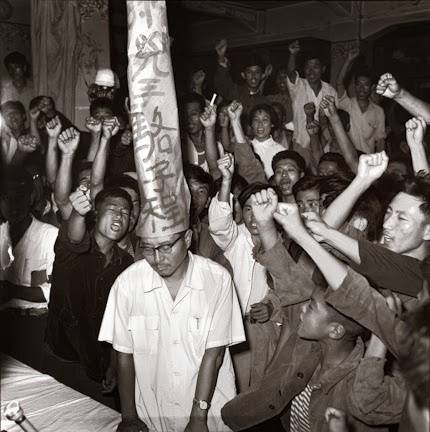
![]() |
| From Photography of China http://www.photographyofchina.com/blog/li-zhensheng |
I have started The Three Body Problem by by Cixin Liu and translated by Ken Liu. I am not too far into it yet - it starts with some of the absolute evils of the Cultural Revolution and as it is portrayed in the book, it is pretty overwhelming (I am not even sure that I can do a Book Beginnings post of it).
While I was reading, for some strange reason, I kept thinking about all those farmers forced to manufacture poor quality steel rather than grow crops, resulting in massive starvation - which was rather distracting me from the story. Maybe my brain was trying to divert me from what was happening to the academics in the story - seeing as how I am one too (an academic but not a part of the story, duh).
It was a relief to get to the 40-plus years later jump.
Where I had another odd problem. Non-spoiler version - I don't know any physicists who would be that freaked out that the universe didn't behave in ways that they expected. For the people I know, that would actually be the equivalent of a shot of adrenaline. I know several people who are actually rather bummed out that nothing really strange has happened in the Large Hadron Collider at CERN.
Either the academics in China are wildly different from the academics I know in the rest of the world (including some colleagues from Japan, Korea, and Cambodia and I don't know all where in Asia - I don't actually demand to know where someone is from when I get into a conversation with them at a conference or meeting) or the author has a rather skewed vision of what academics are really like (hint - most of them are just like - people!) Perhaps this changes as the book moves on.
And can we please get over Einstein and Hawking! For Pete's sake - there are other theoretical physicists in the world - certainly people more relevant to where the story seems to be going - how about Mather and Smoot? Or Makoto Kobayashi and Toshihide Maskawa? Can we namecheck some new people here?
Anyhow - I will keep going and hope to be able to jump into some of the online discussions about this one before everyone else moves on.
Lastly, I have also finished Totaled by Kary English. My reaction is ... mixed. It is generally well-written and has a complete story arc. The idea is interesting... OTOH this is one more story that reminded me of why I pretty much stopped reading SF shorts - I got sick of all the variations of grim. I am sick of stories where scientists in general are portrayed as unethical. And pretty damn resentful of the whole attack on intelligence in general. I really don't like the underlying concept of 'death panels' seeping through the whole thing - this meme prevents there from being a more serious conversation of what measures are necessary and appropriate under circumstances like advanced Alzheimer's or brain death. That's it - the story is a very simplistic take on something that deserves a much fuller and more nuanced exploration. It seems like there should have been something more too it. On the whole the story just left me feeling upset and vaguely ill. I suppose that make it a successful story, if that reaction is more or less what the author was shooting for.
Oh - I almost forgot - I also read “When It Ends, He Catches Her” by Eugie Foster (Daily Science Fiction 9/26/14) - one of the Nebula Award Nominees for Short Story. I went into the story not knowing anything about it, and that helped make the story very, very effective, so I am pretty much not going to say anything about it here other than stating 1) I was quite blown away by this one - just wow and 2) this is not something I would normally read (see the sick of grim comment above) - but I did not finish the story upset or annoyed. No - I finished that story thinking wow - that was well done. Tight, with information and a broader perspective slowly trickling in, making the reader more and more uneasy. Increasing chills and horror. Yep - not my kind of thing at all but tremendously well done so that I appreciated it in spite of myself.
Right - back to grading. Sigh.
Oh man - I totally forgot - I wanted to add this xkcd to my rambling about 3BP ...
Now this ... this is more like the physicists that I know.
Oh man - I totally forgot - I wanted to add this xkcd to my rambling about 3BP ...
Now this ... this is more like the physicists that I know.
Sunday, April 26, 2015
Castle Hangnail by Ursula Vernon
Castle Hangnail
Published by: Dial Books for Young Reader, Penguin
Copyright: 2015 (April 21)
Format: hardback
Pages: 384
Genre: Children's Fantasy
by Ursula Vernon
Published by: Dial Books for Young Reader, Penguin
Copyright: 2015 (April 21)
Format: hardback
Pages: 384
Genre: Children's Fantasy
Age Level: 8 - 12 | Grade Level: 3 - 7
Source: own book
Molly may not be as spectacularly cruel and devilishly demanding as the castle's previous Masters, but when she produces some rather impressive magic, the minions feel hopeful she'll be approved by the Board of Magic. They even start to like her. It turns out though, that Molly is hiding quite a few secrets, including one that could mean the end of Castle Hangnail.
This is actually the first time that I have even read the books description. Ursula Vernon is one of the few (very few at this point) authors whose books I will simply buy as soon as I see her name. In this case, the book showed up in the mail (a pleasant surprise for a lousy week) - I had forgotten I had a standing order in for the next couple books that were coming out.
Source: own book
From the cover
When Molly shows up at Castle Hangnail's doorstep to fill the vacancy for a wicked witch, the castle's minions are suspicious. After all, she is twelve years old, barely five feet tall, and quite ... polite. It's not exactly what they had in mind for wicked. But the castle desperately needs a Master or else the Board of Magic will decommission it, leaving all the minions without the home they love.Molly may not be as spectacularly cruel and devilishly demanding as the castle's previous Masters, but when she produces some rather impressive magic, the minions feel hopeful she'll be approved by the Board of Magic. They even start to like her. It turns out though, that Molly is hiding quite a few secrets, including one that could mean the end of Castle Hangnail.
This is actually the first time that I have even read the books description. Ursula Vernon is one of the few (very few at this point) authors whose books I will simply buy as soon as I see her name. In this case, the book showed up in the mail (a pleasant surprise for a lousy week) - I had forgotten I had a standing order in for the next couple books that were coming out.
So - Molly turns up at Castle Hangnail in answer to this advertisement (on the back cover of the book) ...
Dear Sir or Madam,
Dear Sir or Madam,
The minions of Castle Hangnail seek a new master to overtake all dark and evil duties and responsibilities. Magical abilities are absolutely required,* as is a knack for smiting, blighting, and general malevolent behavior. An intimidating appearance is a plus!
If interested, please send word via raven to the guardian of Castle Hangnail.
*except in the case of Mad Scientists
Sincerely,
the Minions of Castle Hangnail
Once she convinces the guardian of the castle that she is, indeed, a Wicked Witch, she is given a list of Tasks she must complete in order to be accepted as the Master of the Castle.
This is a lovely little story about a young girl seeking a place to belong and be herself. She struggles with taking responsibility for adult sized tasks. There are echoes of Eva Ibbotson (whom the author thanks in the Acknowledgements) with the added benefit that appearance does not equal worth. (Sorry, that was one of the recurring patterns that I realized that I really disliked about Ibbotson's books - the bad people were ugly and the good people were pretty - you didn't even need to read the story to sort out who the bad guys were once you read their descriptions).
Molly is "a plump girl with a round face, a stubborn chin, and frizzy brown hair." Totally unprepossessing for a Wicked Witch. However, she is a witch and while she might only be a bit wicked, she had a kind streak a mile wide and falls in love with the castle and all the minions.
The Castle has been laboring along without a Master for so long, things are literally falling apart in places. It is going to take a concerted effort and lots of work to pull everything together. Plus, there are those pesky secrets of Molly's.
Simply sweet! I really liked it. It is not my favorite Vernon and doesn't have the sarcastic humor that makes the Dragonbreath books such fun to read and re-read. But that said, I can totally see myself as a young girl simply loving this book. I plan to start reading it at bedtime to my daughter to see what she thinks.
Tuesday, March 17, 2015
Twin Spica by Kou Yaginuma - mini gush
Twin Spica - volumes 1 - 3
by Kou Yaginuma
Published in English by Vertical
by Kou Yaginuma
Published in English by Vertical
Format: paperback - my daughter has us calling these backwards books
Published: 2010
Pages: 192 pages (vol 1 & 2), 190 pages (vol 3)
Genre: Manga SciFi/Fantasy
Pages: 192 pages (vol 1 & 2), 190 pages (vol 3)
Genre: Manga SciFi/Fantasy
Source: own book
Summary from Amazon:
In a Tokyo in the not too distant future a young girl studies deligently with ambitions of soon attending space academy. If things work out just right, her future may very well be among the stars as well. And yet, every time she looks up to the stars there is a sense of melancholy in her heart. A sadness surrounds Asumi, as space exploration itself has profoundly impacted her life for as long as she can remember.
But she is not alone...A young man wearing a lion's mask is always beside her. He speaks of the constellations and galaxies as if he they were like home. He knows what it is like to love the stars--slightly bitter and yet always so warm and inviting. Truth is he has gone through much of Asumi is just experiencing. And now in spirit he will forever be with Asumi guiding her on her path to space.
So, due my son's interest in learning Japanese and reading manga I have been on an epic (well - with a little "e" but still) quest to find age appropriate stories for both of my children. I picked up Twin Spica because a) my daughter loves space and b) the idea of going to school to study to be an astronaut would be of interest to both of my kids.
Summary from Amazon:
In a Tokyo in the not too distant future a young girl studies deligently with ambitions of soon attending space academy. If things work out just right, her future may very well be among the stars as well. And yet, every time she looks up to the stars there is a sense of melancholy in her heart. A sadness surrounds Asumi, as space exploration itself has profoundly impacted her life for as long as she can remember.
But she is not alone...A young man wearing a lion's mask is always beside her. He speaks of the constellations and galaxies as if he they were like home. He knows what it is like to love the stars--slightly bitter and yet always so warm and inviting. Truth is he has gone through much of Asumi is just experiencing. And now in spirit he will forever be with Asumi guiding her on her path to space.
So, due my son's interest in learning Japanese and reading manga I have been on an epic (well - with a little "e" but still) quest to find age appropriate stories for both of my children. I picked up Twin Spica because a) my daughter loves space and b) the idea of going to school to study to be an astronaut would be of interest to both of my kids.
I pre-read the story to see what I thought and OMG! - it was complex, deeply melancholy and absolutely fascinating. I was blown away and immediately set about trying to get the rest of the series.
The main character is 13-year old Asumi, a quiet and self-contained dreamer. The "sadness" that surrounds not only Asumi, but pretty much all of the characters is due to the fact that ten years earlier the launch of the first Japanese built space ship was a catastrophic failure. Not only was the ship destroyed, it crashed into a city, resulting in death and destruction from which the country is only just starting to recover. (This isn't a spoiler since it it pretty much spelled out in the first pages of the book).
Despite the fact that Asumi's mother was one of the casualties, she still dreams of flying to the stars.
And I am not even going to try to explain Mr. Lion - that would be a spoiler.
The isn't much in the way of action, but the stories are emotionally gripping. My son grabbed the first book - read it in one gulp, and looked at me with tears in his eyes asking for the next volume. Just wow!
At the moment, I am totally invested in this story and want to know how it is resolved. I just hope that the emotional ride has a solid, and uplifting, finish. My son is fairly heartbroken for Asumi right now and is also waiting to see what happens next.
Saturday, February 21, 2015
The Eye of Zoltar by Jasper Fforde - eek!
The Eye of Zoltar
The Chronicles of Kazam, Book 3
by Jasper Fforde
Published by: Houghton Mifflin Harcourt Publishing
Copyright: 2014
Format: hardback
Pages: 405
Genre: YA Fantasy
Source: own book
From the cover:
Although she’s an orphan in indentured servitude, sixteen-year-old Jennifer Strange is pretty good at her job of managing the unpredictable crew at Kazam Mystical Arts Management. She already solved the Dragon Problem, avoided mass destruction by Quarkbeast, and helped save magic in the Ununited Kingdoms. Yet even Jennifer may be defeated when the long-absent Mighty Shandar makes an astonishing appearance and commands her to find the Eye of Zoltar—proclaiming that if she fails, he will eliminate the only two dragons left on earth.
How can a teenage non-magician outdo the greatest sorcerer the world has ever known? But failure is unacceptable, so Jennifer must set off for the mysterious Cadir Idris in the deadly Cambrian Empire—a destination with a fatality index of fifty percent. With the odds against them, will Jennifer and her traveling companions ever return to the Kingdom of Snodd?
I have no idea what to do with this one. This is the third book in the series, and it won't make the slightest bit of sense if you haven't read the first two: The Last Dragonslayer and The Song of the Quarkbeast. If you have read the first two, and liked them, you need to read this one too. However - I found it way, way bleaker and darker than the previous two. The events were pretty heavy and the, um, callous way things were presented and handled made me pretty unhappy. I was going to be pretty ticked with then book overall and was planning to say simply ugh - and then we came to the end - which I can't discuss at all because a) total spoilers and b) Holy Cliffhanger!!! but wow - I NEED THE NEXT BOOK NOW! And there isn't any sign of it on-line - like a projected publication date or tentative title - anything to demonstrate that it will even exist other than the way that this book ended
The Chronicles of Kazan will continue ...
They bloody well better, 'cause Holy Cow!
I am still not particularly happy with events in story and really disliked one aspect that, again, I can't mention because it would be a massive spoiler. ARGH! Suffice it to say that this book does not end with a traditional HEA. OTOH, the story certainly avoids the problem of being a torturous placeholder, like the recent Finishing School book.
I have no idea what else to say about any of this, so I am going to give up now.
The Chronicles of Kazam, Book 3
by Jasper Fforde
Published by: Houghton Mifflin Harcourt Publishing
Copyright: 2014
Format: hardback
Pages: 405
Genre: YA Fantasy
Source: own book
From the cover:
Although she’s an orphan in indentured servitude, sixteen-year-old Jennifer Strange is pretty good at her job of managing the unpredictable crew at Kazam Mystical Arts Management. She already solved the Dragon Problem, avoided mass destruction by Quarkbeast, and helped save magic in the Ununited Kingdoms. Yet even Jennifer may be defeated when the long-absent Mighty Shandar makes an astonishing appearance and commands her to find the Eye of Zoltar—proclaiming that if she fails, he will eliminate the only two dragons left on earth.
How can a teenage non-magician outdo the greatest sorcerer the world has ever known? But failure is unacceptable, so Jennifer must set off for the mysterious Cadir Idris in the deadly Cambrian Empire—a destination with a fatality index of fifty percent. With the odds against them, will Jennifer and her traveling companions ever return to the Kingdom of Snodd?
I have no idea what to do with this one. This is the third book in the series, and it won't make the slightest bit of sense if you haven't read the first two: The Last Dragonslayer and The Song of the Quarkbeast. If you have read the first two, and liked them, you need to read this one too. However - I found it way, way bleaker and darker than the previous two. The events were pretty heavy and the, um, callous way things were presented and handled made me pretty unhappy. I was going to be pretty ticked with then book overall and was planning to say simply ugh - and then we came to the end - which I can't discuss at all because a) total spoilers and b) Holy Cliffhanger!!! but wow - I NEED THE NEXT BOOK NOW! And there isn't any sign of it on-line - like a projected publication date or tentative title - anything to demonstrate that it will even exist other than the way that this book ended
The Chronicles of Kazan will continue ...
They bloody well better, 'cause Holy Cow!
I am still not particularly happy with events in story and really disliked one aspect that, again, I can't mention because it would be a massive spoiler. ARGH! Suffice it to say that this book does not end with a traditional HEA. OTOH, the story certainly avoids the problem of being a torturous placeholder, like the recent Finishing School book.
I have no idea what else to say about any of this, so I am going to give up now.
Wednesday, February 11, 2015
Fairest by Marissa Meyer - mini rant!
Fairest
by Marissa Meyer
Published by: Feiwel & Friends
Copyright: January 27, 2015
Format: hardback
Pages: 272 BUT only around 200 are actually the story!
Genre: YA SciFi/Fantasy; The Lunar Chronicles book 3.5 - i.e. book lets milk this thing for all it's worth
Source: own book
From Amazon:
Mirror, mirror, on the wall.
Who is the Fairest of them all?
Pure evil has a name, hides behind a mask of deceit, and uses her "glamour" to gain power. But who is Queen Levana? Long before she crossed paths with Cinder, Scarlet, and Cress in The Lunar Chronicles, Levana lived a very different story—a story that has never been told . . . until now.
Sigh. As you might already guess - I am a bit cranky about this entry into the series - scratch that - I am seriously displeased.
A) it was way too short for a hardback with a $17.99 price point. Seriously, only around 200 well spaced pages are the story and you are paying for the pleasure of previewing the first bit of Winter. If the words were appropriately white-spaced this would be considered a novella.
B) it reads like the character outline notes that an author jots down to flesh out a character in their own mind. The stuff that helps the author sort out motivations for a character but that never appears verbatim in a good book. Here it was barely fleshed out. The story skips the events that might have actually proved interesting. There are giant time gaps where everything blurs past and you find yourself flipping backwards to see if you somehow missed a page. Seriously, anything that would actually have provided tension or drama was over in less than half a page and then referred to as something in the past. Any actual action happened firmly off page. [I take that back - one event happened on page and it was the only one with any real impact].
C) The "evilest one of all" should not be a terminal sad-sack for most of her book. For a book theoretically about Levana and how she got to where she is, it really does nothing to further her as a character than what anyone would have gathered/assumed from simply reading the first three books in the series. Worse actually, because it steals away some of her agency. This would have been better if the story simply went for full-bore crazy or steely focus on her goals at the expense of everything else - though I think we are supposed to believe that happens by the end. (And I don't get people saying that she was "an entitled brat" or some variation of that 'cause, um, nope - brat is temporary and for kids, her behavior even at 16 was seriously off kilter, even at the start - the problem is that it wasn't consistent.) Also Levana could still believe that she is the hero of her own story, but others around her should have been reacting to something - that is how you make reader understand how the characters behavior fits into the world of the story. As it was the whole thing reads as beige monotone.
D) The lack of serious Lunar world-building is a huge flaw now. World-building has always been a problem with this series but there was usually enough going on to carry the story through. Here the lack of clarity makes the whole short story a blurry mess with only - what 5? 6? - named characters. The whole d*man Lunar court and the book treats them as basically invisible. What the heck?
E) Goes into some seriously questionable territory - I am not sure it is appropriate for this series considering the age range of some of the readers of the previous three book.
SPOILERS - Look away if you don't want to know -
Apparently we are supposed to believe that Levana finally breaks goes all nuts and coldly vengeful because her love was unrequited. Not because her heart was actually broken or that some guy was bad to her (which was more or less the trope I was expecting). Nope - it was because the object of her obsession was nice to her but didn't love her. Poor Levana, terrible victim of her first crush not crushing back. Never-mind the whole jacked up mess that consisted of her family life and isolation in the court - apparently that wasn't enough to motivate her to do something and actually own her actions. I get that she is supposed to be unstable but this was just lame. Facing the fact that the "happy family" she created didn't really exist would only have had some weight if there was ever a feeling that it had existed at some point. But it never did. The whole thing was poorly constructed and doesn't work.
Sheesh - give me a villain that takes responsibility for their actions because they are sure that they are doing the right thing over a milquetoast poor me, it's not fault drippy villain any day.
She doesn't even get to be responsible for the grand plan to take over the Earth - her father actually started it all. That ticked me off. I don't remember any of the other three books indicating that someone else was responsible for kicking this off - I thought that the plague and antidote thing was Levana's master scheme. Now she doesn't even get to own that. Her big contribution was to really like the plan and keep it moving forward.
Finally, my huge issue is that the story basically hinges on use of mind control to exploit a non-consenting person for sex and eventually forced marriage. So basically rape, on an ongoing basis for years. That is just sick. But the way the story frames it, it seems we are supposed to feel sorry for Levana. Which is even sicker. The story hedges around dealing with the full horror of what Levana was doing to another person.
Is the book trying to use this to prove to us that not only is Levana evil, but pretty much the entire Lunar court is too? I mean, she couldn't have gotten away with this stuff if she didn't have support. Which brings up the question, why does anyone support her ? Seriously - if she had been seen as weak and ineffectually for the majority of her life, why would the court even give her the chance to find her bearings and start turning into a magnificent, powerful evil queen ? We are beaten over the head with the fact that she is an outsider with no respect in the court. But suddenly everyone listens to her and respects her ? The book tries to convince us that this is because her sister delegates responsibility to her, but I don't buy it. If there was any chance that she would have power - there should have been plenty of people trying to curry favor, just in case. There should never have been the whole "my only present" thing. Seriously - you can't be a poor, pathetic little girl and the second most powerful person in the court at the same time. Levana could believe she was a poor little thing, but the actions of the people around her should have been wildly different. It just didn't make any sense. And I still don't get it - is the entire court supposed to be twisted and lacking any sense of morality or not? And the entire rest of the population puts up with this because mind control?
Speaking of things that don't make sense - we are basically told flat out that the members of the royal family and lunar royal court are highly promiscuous and that there is no stigma attached to being born out of wedlock - there should be tons of people with at least some royal blood running around. If the court was as twisted as it appears to be, someone should have offed Levana ages ago to take over the throne. You can see her sister surviving because she was a full member of the bent and twisted club. Levana going through her poor me phase, she shouldn't have even survived.
I finished the book just not sure what the heck I was supposed to make of this stuff. It didn't do any world-building for the Lunar court. For the most part, it didn't add anything we didn't already know, other then building this GIANT out for Winter not being a horrible person (which I am assuming is being presented as at least semi-genetic?). And it didn't do anything much for Levana - there was just way too much emphasis on distancing her character from any sort of agency at all most of the time, in some sort of attempt to make her seem more sympathetic I guess. And yes, I get that this is being told from Levana's point of view - so she totally can see herself as a helpless victim, great hero, or poor-me if she wants - but the BOOK should be providing the external information that puts Levana's story into some broader perspective. Because of the lack of world-building, and the fact that key events are generally glossed over, you never really get the sense of perspective nor real growth or change for Levana. Instead of making Levana a more rounded character it undercut her completely. She is way less interesting to me now than she was at the end of Cress.
END SPOILERS - Don't look up ! -
My sum up ...
Unless you are a diehard fan, I suggest skipping this book. If you are a diehard fan and just need to know, check it out from a library first to see if you really need it to complete your set, just so you don't end up getting ticked off at the amount of money you would have to spend for this little novella. I really think this entry does a disservice to the series and is better skipped.
by Marissa Meyer
Published by: Feiwel & Friends
Copyright: January 27, 2015
Format: hardback
Pages: 272 BUT only around 200 are actually the story!
Genre: YA SciFi/Fantasy; The Lunar Chronicles book 3.5 - i.e. book lets milk this thing for all it's worth
Source: own book
From Amazon:
Mirror, mirror, on the wall.
Who is the Fairest of them all?
Pure evil has a name, hides behind a mask of deceit, and uses her "glamour" to gain power. But who is Queen Levana? Long before she crossed paths with Cinder, Scarlet, and Cress in The Lunar Chronicles, Levana lived a very different story—a story that has never been told . . . until now.
Sigh. As you might already guess - I am a bit cranky about this entry into the series - scratch that - I am seriously displeased.
A) it was way too short for a hardback with a $17.99 price point. Seriously, only around 200 well spaced pages are the story and you are paying for the pleasure of previewing the first bit of Winter. If the words were appropriately white-spaced this would be considered a novella.
B) it reads like the character outline notes that an author jots down to flesh out a character in their own mind. The stuff that helps the author sort out motivations for a character but that never appears verbatim in a good book. Here it was barely fleshed out. The story skips the events that might have actually proved interesting. There are giant time gaps where everything blurs past and you find yourself flipping backwards to see if you somehow missed a page. Seriously, anything that would actually have provided tension or drama was over in less than half a page and then referred to as something in the past. Any actual action happened firmly off page. [I take that back - one event happened on page and it was the only one with any real impact].
C) The "evilest one of all" should not be a terminal sad-sack for most of her book. For a book theoretically about Levana and how she got to where she is, it really does nothing to further her as a character than what anyone would have gathered/assumed from simply reading the first three books in the series. Worse actually, because it steals away some of her agency. This would have been better if the story simply went for full-bore crazy or steely focus on her goals at the expense of everything else - though I think we are supposed to believe that happens by the end. (And I don't get people saying that she was "an entitled brat" or some variation of that 'cause, um, nope - brat is temporary and for kids, her behavior even at 16 was seriously off kilter, even at the start - the problem is that it wasn't consistent.) Also Levana could still believe that she is the hero of her own story, but others around her should have been reacting to something - that is how you make reader understand how the characters behavior fits into the world of the story. As it was the whole thing reads as beige monotone.
D) The lack of serious Lunar world-building is a huge flaw now. World-building has always been a problem with this series but there was usually enough going on to carry the story through. Here the lack of clarity makes the whole short story a blurry mess with only - what 5? 6? - named characters. The whole d*man Lunar court and the book treats them as basically invisible. What the heck?
E) Goes into some seriously questionable territory - I am not sure it is appropriate for this series considering the age range of some of the readers of the previous three book.
SPOILERS - Look away if you don't want to know -
Apparently we are supposed to believe that Levana finally breaks goes all nuts and coldly vengeful because her love was unrequited. Not because her heart was actually broken or that some guy was bad to her (which was more or less the trope I was expecting). Nope - it was because the object of her obsession was nice to her but didn't love her. Poor Levana, terrible victim of her first crush not crushing back. Never-mind the whole jacked up mess that consisted of her family life and isolation in the court - apparently that wasn't enough to motivate her to do something and actually own her actions. I get that she is supposed to be unstable but this was just lame. Facing the fact that the "happy family" she created didn't really exist would only have had some weight if there was ever a feeling that it had existed at some point. But it never did. The whole thing was poorly constructed and doesn't work.
Sheesh - give me a villain that takes responsibility for their actions because they are sure that they are doing the right thing over a milquetoast poor me, it's not fault drippy villain any day.
She doesn't even get to be responsible for the grand plan to take over the Earth - her father actually started it all. That ticked me off. I don't remember any of the other three books indicating that someone else was responsible for kicking this off - I thought that the plague and antidote thing was Levana's master scheme. Now she doesn't even get to own that. Her big contribution was to really like the plan and keep it moving forward.
Finally, my huge issue is that the story basically hinges on use of mind control to exploit a non-consenting person for sex and eventually forced marriage. So basically rape, on an ongoing basis for years. That is just sick. But the way the story frames it, it seems we are supposed to feel sorry for Levana. Which is even sicker. The story hedges around dealing with the full horror of what Levana was doing to another person.
Is the book trying to use this to prove to us that not only is Levana evil, but pretty much the entire Lunar court is too? I mean, she couldn't have gotten away with this stuff if she didn't have support. Which brings up the question, why does anyone support her ? Seriously - if she had been seen as weak and ineffectually for the majority of her life, why would the court even give her the chance to find her bearings and start turning into a magnificent, powerful evil queen ? We are beaten over the head with the fact that she is an outsider with no respect in the court. But suddenly everyone listens to her and respects her ? The book tries to convince us that this is because her sister delegates responsibility to her, but I don't buy it. If there was any chance that she would have power - there should have been plenty of people trying to curry favor, just in case. There should never have been the whole "my only present" thing. Seriously - you can't be a poor, pathetic little girl and the second most powerful person in the court at the same time. Levana could believe she was a poor little thing, but the actions of the people around her should have been wildly different. It just didn't make any sense. And I still don't get it - is the entire court supposed to be twisted and lacking any sense of morality or not? And the entire rest of the population puts up with this because mind control?
Speaking of things that don't make sense - we are basically told flat out that the members of the royal family and lunar royal court are highly promiscuous and that there is no stigma attached to being born out of wedlock - there should be tons of people with at least some royal blood running around. If the court was as twisted as it appears to be, someone should have offed Levana ages ago to take over the throne. You can see her sister surviving because she was a full member of the bent and twisted club. Levana going through her poor me phase, she shouldn't have even survived.
I finished the book just not sure what the heck I was supposed to make of this stuff. It didn't do any world-building for the Lunar court. For the most part, it didn't add anything we didn't already know, other then building this GIANT out for Winter not being a horrible person (which I am assuming is being presented as at least semi-genetic?). And it didn't do anything much for Levana - there was just way too much emphasis on distancing her character from any sort of agency at all most of the time, in some sort of attempt to make her seem more sympathetic I guess. And yes, I get that this is being told from Levana's point of view - so she totally can see herself as a helpless victim, great hero, or poor-me if she wants - but the BOOK should be providing the external information that puts Levana's story into some broader perspective. Because of the lack of world-building, and the fact that key events are generally glossed over, you never really get the sense of perspective nor real growth or change for Levana. Instead of making Levana a more rounded character it undercut her completely. She is way less interesting to me now than she was at the end of Cress.
END SPOILERS - Don't look up ! -
My sum up ...
Unless you are a diehard fan, I suggest skipping this book. If you are a diehard fan and just need to know, check it out from a library first to see if you really need it to complete your set, just so you don't end up getting ticked off at the amount of money you would have to spend for this little novella. I really think this entry does a disservice to the series and is better skipped.
Sunday, February 8, 2015
The Secret Rooms by Catherine Bailey
The Secret Rooms: A True Story of A Haunted Castle, A Plotting Duchess, & A Family Secretby Catherine Bailey
Published by: Penguin Books
Copyright: December 31, 2013
Format: paperback
Pages: 512
Genre: Nonfiction, WWI, British History
Source: own book
From the back of the book:
When the 9th Duke of Rutland died alone in the cramped family archives on April 21, 1940, his son and heir, Charles, ordered the room sealed. Sixty years later, Catherine Bailey became one of the first historians allowed inside. What she discovered when she began reading through the duke's letters was a mystery involving one of the most powerful families in British society in the turbulent days leading up to World War I. The 9th Duke, who had devoted his entire adult life to organizing and cataloging several hundred years' worth of family correspondence, had carefully erased three periods of his life from the record. But why? Filled with fascinating real-life characters, a mysterious death, family secrets and affairs aplenty, The Secret Rooms is an enthralling, page-turning true story that reads like an Agatha Christie novel.
First - I think they rather mis-marketed this book. The title of this book is horribly misleading. There is no haunted castle - just a couple of random stories like those you would hear associated with any house that old and that are only mentioned in passing - so if you are expecting a ghost story, you are going to be sadly disappointed. There is a plotting duchess and a family secret, but honestly - they were not what made the book interesting to me. Finally, the secret rooms were not, in any way, actually secret. Everyone knew precisely where they were (they are clearly marked on the map in the book). They were just off limits. A better title would have been Secrets Rooms - i.e. rooms that held secrets.
The book really is the story of the author, who was in the process of researching a book about WWI. She was one of the first historians allowed into the archives of Belvoir Castle. Once there, instead of getting the information she was looking for about the war, she ran into a very precise gap in the records. Instead of being able to pursue her original plan, she gets derailed into trying to figure out why the 9th Earl of Rutland spend the last days of his life carefully destroying all the letters he could find for three very specific ranges of dates.
The first part of the book jumps around a bit - with rather too much emphasis on the whole 'curse on first sons' and 'deep dark secrets' thing trying to evoke the feeling of a Gothic novel almost - but was still fun to read as you followed the author around in her attempt to fill in the gaps and figure out what happened to John Manners (who became the 9th Duke of Rutland) during those periods of time.
The second half of the book is a rather more straightforward narrative, where the author explains what she pieced together once she gets her hands on the few letters that survived. It gets a bit bogged down as the reader goes mentally back and forth trying to tie together the information fed out piecemeal in the first half of the book into the narrative in the second half of the book. On the whole, however, the book offers a fascinating (and in several ways appalling) view into WWI and the activities of one very influential family.
However, I really hated the way the author chose to end the book. The current Duke and his wife were apparently very helpful in terms of giving the author access to the archives, and in giving her permission to publish something completely different than the WWI book she was originally proposing to write. The book certainly doesn't paint most of the Dukes ancestors in a positive light at all. The way the book ended, it felt like the author was still extremely mad at the 9th Duke for terminating her original line of research (she lists the names of all of the soldiers whose stories she could no longer follow in the book - though honestly, if she was depending on the letters home of a single ADC - their story still would have been pretty impossible to tell - what if John had only written home about personal stuff and not the war, or what if he was a lousy correspondent? The frustration of finding that John had initially kept a detailed and well written journal and then learn that the time period she was interested in either suddenly disconnected or had been destroyed must really have gotten under her skin.) The ending of the book was really abrupt, piecemeal and unsatisfying. Seriously - at that point, to heck with John and his lot - she gave them their piece. What about tying together the WWI story and bringing it forward to modern times? That would have been much more satisfactory. Instead the end left me ticked off too.
So - some mixed feeling about this one. Initially I was enjoying the book very much, not for the "secrets" but for the history and sociology - information about the activities of some of the British Aristocracy leading up to World War I and just how badly the war was being run initally. It is a fascinating portrait of a time and lifestyle completely alien to a modern American. I just wish it could have tied up better. I felt rather cheated and left with the sludge of some seriously nasty people. Blugh.
So - the other bit of mismarketing was how promotional material related the book to Downtown Abbey. I can only assume they did that because someone decided that the only information Americans have about Great Britain in WWI is through the PBS series. They are not related. You do have intrigue and such, but it is not akin to watching Upstairs/Downstairs. If you were disappointed by how Downtown Abbey presented WWI and are interested in a more detailed description of the interactions of a Dukedom with the flow of historical events, this book might be of interest to you. If you are reading the book for a deep historical mystery with a dramatic reveal, you are going to be disappointed.
Mostly it is a serious history that got overlain by the machinations of a seriously dysfunctional family with too much power. If that interests you, it will be worth the 500+ pages.
Sunday, January 18, 2015
A Natural History of Dragons by Marie Brennan (mini review)
A Natural History of Dragons: A Memoir by Lady Trent by Marie Brennan
Published by: Tor
Copyright: 2013
Format: paperback
Pages: 334
Genre: Fantasy, Dragons!
Source: own book
From the back cover:
All the world, from Scirland to the furthest research of Eriga, knows Isabella, Lady Trent, to be the world's preeminent dragon naturalist. She is the remarkable woman who brought the study of dragons out of the misty shadows of myth and misunderstanding into the clear light of modern science. But before she became the illustrious figure we know today, there was a bookish young woman whose passion for learning, natural history, and, yes, dragons, defied the stifling conventions of her day.
Here, at last, in her own words, in the true story of a pioneering spirit who risked her reputation, her prospects, and her fragile flesh and bone to satisfy her scientific curiosity; of how she sought true love and happiness despite her lamentable eccentricities; and of her thrilling expedition to the perilous mountains of Vystrana, where she made the first of many historic discoveries that would change the world forever.
I am sorry that I waited so long to read this. Wow - it was just lovely and almost a perfect read for me. The book does really feel like a Victorian Lady Travels to X Place novel - reminding me strongly of Crocodile on the Sandbank by Elizabeth Peters, which is one of my favorite books ever. The author did a wonderful job with the worldbuilding and evoking a period feeling.
I really liked how the developing relationship was handled as well. I have never quite gotten my head around the idea that women had to be married off before they were 25 or they went stale or something - married at 19 and the adjustments and everything, especially given how sheltered upper class girls were - it must have been so tough and overwhelming. I thought this was well done and that the author managed a delicate balance in the narrative that emulated a person writing about these issues but still maintaining a polite distance from the overly personal.
Some might find the pace of the book slow, and overly descriptive, but I loved it. I am very much looking forward to the next book.
Saturday, January 10, 2015
The School for Good and Evil by Soman Chainani
The School for Good and Evil
by Soman Chainani
Published by: HarperCollins Publishers
Publication Date: May 14, 2013
Format: ebook
Copyright: 2014
Pages: 512
Genre: Middle-Grade Fiction - Fairytale retelling
Source: own book
From Amazon:
At the School for Good and Evil, failing your fairy tale is not an option.
Welcome to the School for Good and Evil, where best friends Sophie and Agatha are about to embark on the adventure of a lifetime. With her glass slippers and devotion to good deeds, Sophie knows she'll earn top marks at the School for Good and join the ranks of past students like Cinderella, Rapunzel, and Snow White.
Meanwhile, Agatha, with her shapeless black frocks and wicked black cat, seems a natural fit for the villains in the School for Evil.
The two girls soon find their fortunes reversed—Sophie's dumped in the School for Evil to take Uglification, Death Curses, and Henchmen Training, while Agatha finds herself in the School for Good, thrust among handsome princes and fair maidens for classes in Princess Etiquette and Animal Communication. But what if the mistake is actually the first clue to discovering who Sophie and Agatha really are . . . ? The School for Good and Evil is an epic journey into a dazzling new world, where the only way out of a fairy tale is to live through one.
All I can say is good grief what a load of dingo's kidneys.
Fair warning, this might get a bit spoilery because this book just ticked me off so much. I am going to try and avoid giving away too much but I might let some things slip.
I have had this book shoved to my attention for what feels like ages, so when I saw it on sale at Amazon for $1.99, I finally decided to give it a go. I like fairy tale retellings and the premise sounded somewhat promising.
Turns out I should have given it a pass. Ugh what a wet mess. The idea that the "ugly" girl is the good one and the "beautiful" girl is the evil one is not exactly groundbreaking here but has been treated as something amazingly subversive and trope upending by lots of reviewers out there. Okay - I was willing to give it a chance, considering much of the stuff that gets published, this sounded like it was at least going to be a chance of pace.
Turns out to be a throughly shallow treatment though because as the story progresses, 'good' girls get prettier and 'evil' girls get uglier - so much for that subversive idea. And for some reason the whole Evil School is populated by the unwashed, unkempt and imperfect, because clearly that all equals evil, right? Excuse me? Some of the best fairy tale villains were quite beautiful or handsome. What the heck does lack of traditional beauty or inability to blend in with peers have to do with evil?
Someone failed Shakespeare - That one may smile, and smile, and be a villain
— Hamlet Act 1, scene 5
The book gives lip service to the idea that actions speak louder than appearances, but doesn't actually make that happen in the plot. Not to mention the fact that the whole 'I want to be an evil villain just because!' thing has never made sense to me. There are some stabs at explaining motivations but they mostly fall flat because the worldbuilding is so nonsensical.
More Shakespeare !
I completely hated the whole your soul is either all evil or all good - you were born that way - and there isn't anything you can do about it. I managed to swallow it down and hope that this was going to be blown apart in the course of the story.
Speaking of inexplicable - apparently murder is common, right since it is common in fairy tales, but only the truly evil can be murders, so really murdering someone is too evil, except at the beginning of the book, and multiple times throughout actually, her roommates threaten, plan, attempt to murder Sophie. Then later in the book they act all shocked about the idea of murder. And someone does actually commit a murder but the only consequences are occasional feelings of nausea. Wait, what ?
And this kind of thing is true throughout the book. Every characters actions and motivations are whatever they need to be at that point in the narrative, never mind the fact that they were completely different just a few pages or even paragraphs ago.
The book starts out promisingly, laying out threads that could have gone somewhere - like perhaps the critical idea that the world isn't totally black and white, and really following through with the ugly does not equal evil. There were lots of ways that this could have been a really good book. It bailed on every single one of them. Sigh.
And the ending! ARGH! Mass slaughter but hey, everything is okay for 'our hero' so that equals 'happy ending' (such as it ended - it was pretty abrupt for such a long, wordy and repetitive book.)
However - at the very end of the book the way that the internal fairy tale ended, the trigger, I really liked that idea. Too bad it was tied up with the extremely harmful idea that good is always required to forgive - no matter how badly someone else has treated them or others - no matter how terrible someone else is. That is a recipe for abuse right there.
And the writing was occasionally a bit of a train wreck. There were several places where I re-read sections of text that jumped from point A to point B like something critical and revealing had happened, but there was nothing connecting them. Either the ebook version is missing chunks of text or this book needed a much better editor.
Stuff like this (there are worse examples but they are all spoilers) ...
"The west doors flew open to sixty gorgeous boys in swordfight.
Sun-kissed skin peeked through light blue sleeves and stiff collars; tall navy boots matched high-cut waistcoats and knotted slim ties, each embroidered with a single gold initial."
I flipped back and forth several times trying to find the rest of that first sentence. Just huh?
Sigh. No fun. No fun at all. I certainly am not interested in the second book and don't get why this one was so popular at all.
by Soman Chainani
Published by: HarperCollins Publishers
Publication Date: May 14, 2013
Format: ebook
Copyright: 2014
Pages: 512
Genre: Middle-Grade Fiction - Fairytale retelling
Source: own book
From Amazon:
At the School for Good and Evil, failing your fairy tale is not an option.
Welcome to the School for Good and Evil, where best friends Sophie and Agatha are about to embark on the adventure of a lifetime. With her glass slippers and devotion to good deeds, Sophie knows she'll earn top marks at the School for Good and join the ranks of past students like Cinderella, Rapunzel, and Snow White.
Meanwhile, Agatha, with her shapeless black frocks and wicked black cat, seems a natural fit for the villains in the School for Evil.
The two girls soon find their fortunes reversed—Sophie's dumped in the School for Evil to take Uglification, Death Curses, and Henchmen Training, while Agatha finds herself in the School for Good, thrust among handsome princes and fair maidens for classes in Princess Etiquette and Animal Communication. But what if the mistake is actually the first clue to discovering who Sophie and Agatha really are . . . ? The School for Good and Evil is an epic journey into a dazzling new world, where the only way out of a fairy tale is to live through one.
All I can say is good grief what a load of dingo's kidneys.
Fair warning, this might get a bit spoilery because this book just ticked me off so much. I am going to try and avoid giving away too much but I might let some things slip.
I have had this book shoved to my attention for what feels like ages, so when I saw it on sale at Amazon for $1.99, I finally decided to give it a go. I like fairy tale retellings and the premise sounded somewhat promising.
Turns out I should have given it a pass. Ugh what a wet mess. The idea that the "ugly" girl is the good one and the "beautiful" girl is the evil one is not exactly groundbreaking here but has been treated as something amazingly subversive and trope upending by lots of reviewers out there. Okay - I was willing to give it a chance, considering much of the stuff that gets published, this sounded like it was at least going to be a chance of pace.
Turns out to be a throughly shallow treatment though because as the story progresses, 'good' girls get prettier and 'evil' girls get uglier - so much for that subversive idea. And for some reason the whole Evil School is populated by the unwashed, unkempt and imperfect, because clearly that all equals evil, right? Excuse me? Some of the best fairy tale villains were quite beautiful or handsome. What the heck does lack of traditional beauty or inability to blend in with peers have to do with evil?
Someone failed Shakespeare - That one may smile, and smile, and be a villain
— Hamlet Act 1, scene 5
The book gives lip service to the idea that actions speak louder than appearances, but doesn't actually make that happen in the plot. Not to mention the fact that the whole 'I want to be an evil villain just because!' thing has never made sense to me. There are some stabs at explaining motivations but they mostly fall flat because the worldbuilding is so nonsensical.
More Shakespeare !
and it better fits my blood to be disdained of all than to
fashion a carriage to rob love from any. In this, though I
cannot be said to be a flattering honest man, it must not be
denied but I am a plain-dealing villain. I am trusted with a
muzzle and enfranchised with a clog; therefore I have
decreed not to sing in my cage. If I had my mouth, I would
bite; if I had my liberty, I would do my liking. In the
meantime, let me be that I am, and seek not to alter me.
— Much Ado About Nothing Act 1, scene 3I completely hated the whole your soul is either all evil or all good - you were born that way - and there isn't anything you can do about it. I managed to swallow it down and hope that this was going to be blown apart in the course of the story.
Speaking of inexplicable - apparently murder is common, right since it is common in fairy tales, but only the truly evil can be murders, so really murdering someone is too evil, except at the beginning of the book, and multiple times throughout actually, her roommates threaten, plan, attempt to murder Sophie. Then later in the book they act all shocked about the idea of murder. And someone does actually commit a murder but the only consequences are occasional feelings of nausea. Wait, what ?
And this kind of thing is true throughout the book. Every characters actions and motivations are whatever they need to be at that point in the narrative, never mind the fact that they were completely different just a few pages or even paragraphs ago.
The book starts out promisingly, laying out threads that could have gone somewhere - like perhaps the critical idea that the world isn't totally black and white, and really following through with the ugly does not equal evil. There were lots of ways that this could have been a really good book. It bailed on every single one of them. Sigh.
And the ending! ARGH! Mass slaughter but hey, everything is okay for 'our hero' so that equals 'happy ending' (such as it ended - it was pretty abrupt for such a long, wordy and repetitive book.)
However - at the very end of the book the way that the internal fairy tale ended, the trigger, I really liked that idea. Too bad it was tied up with the extremely harmful idea that good is always required to forgive - no matter how badly someone else has treated them or others - no matter how terrible someone else is. That is a recipe for abuse right there.
And the writing was occasionally a bit of a train wreck. There were several places where I re-read sections of text that jumped from point A to point B like something critical and revealing had happened, but there was nothing connecting them. Either the ebook version is missing chunks of text or this book needed a much better editor.
Stuff like this (there are worse examples but they are all spoilers) ...
"The west doors flew open to sixty gorgeous boys in swordfight.
Sun-kissed skin peeked through light blue sleeves and stiff collars; tall navy boots matched high-cut waistcoats and knotted slim ties, each embroidered with a single gold initial."
I flipped back and forth several times trying to find the rest of that first sentence. Just huh?
Sigh. No fun. No fun at all. I certainly am not interested in the second book and don't get why this one was so popular at all.
Thursday, January 8, 2015
The Seventh Bride by T. Kingfisher
The Seventh Bride
by T. Kingfisher (aka Ursula Vernon)
Publisher: Red Wombat Tea Company
Format: ebook
Published: November 11, 2014
Sold by: Amazon Digital Services, Inc.
Print Length: 183 pages
Genre: Fiction - Fairy Tale/Horror
Source: purchased
From the T Kingfisher website:
This hedgehog has nothing to do with the story - it is just an example of some of Ursula Vernon's wonderful art.
But now, just because I have to ...
'kay I am better now,
by T. Kingfisher (aka Ursula Vernon)
Publisher: Red Wombat Tea Company
Format: ebook
Published: November 11, 2014
Sold by: Amazon Digital Services, Inc.
Print Length: 183 pages
Genre: Fiction - Fairy Tale/Horror
Source: purchased
From the T Kingfisher website:
Rhea is an ordinary miller’s daughter,
engaged to be married under suspicious circumstances to a man not of her
choosing.
He has unknown powers and a manor house full of mysterious women.
Rhea has a hedgehog. It claims to be ordinary, but normal hedgehogs don’t act like that.
It’s probably not going to be enough.
He has unknown powers and a manor house full of mysterious women.
Rhea has a hedgehog. It claims to be ordinary, but normal hedgehogs don’t act like that.
It’s probably not going to be enough.
Sigh. I am such an Ursula Vernon fangirl that I would probably read her grocery list and like it. Somehow I missed this one when it came out - probably because I was focused on waiting for Dragonbreath: Knight-Napped! which (squee!) is sitting on the desk next to me. I have to read it at lunch becuase as soon as I take it home my son is going to steal it to read.
So - I have to admit that I think I liked Nine Goblins a bit better, but still - this is pretty cool. It is an interesting take on the Bluebeard idea, where Rhea finds herself 'engaged' to an off-putting Lord. Rhea, our narrator, has a good, strong, young-girl-in-over-her-head voice. She might be a little slow to pick up some of the clues being laid out, but not unbearably so. She also tends to admit that she should have seen something coming - and it makes sense in a I still can't believe/cope with the things that are happening around me sort of way.
The story is Coraline-ish level creepy - not for children but should be find for older teens.
There are a few lines that I absolutely adored - mostly involving the hedgehog, because hedgehogs are awesome - but I am going to refrain from sharing them because I want to encourage everyone to go try this one themselves. Well worth your time.
It is only available as an ebook
![]() |
| The Hedgehog's Balloon by Ursula Vernon http://www.redwombatstudio.com/product/the-hedgehogs-balloon/ |
But now, just because I have to ...
Hedgehog squeeeeee !
'kay I am better now,
Tuesday, January 6, 2015
Waistcoats and Weaponry by Gail Garriger
Waistcoats and Weaponry
Finishing School Book the Third
by Gail Carriger
Published: Little Brown and Company, Hachette Book Group
Format: Hardback
Copyright: 2014
Pages: 298
Genre: Fiction - Steampunkish
Source: own book
From the cover:
Class is back in session. Sophronia continues finishing school in style – with a steel-bladed fan secreted in the folds of her ball gown, of course. Such a fashionable choice of weapon comes in handy when Sophronia, her best friend Dimity, sweet sootie Soup, and the charming Lord Felix Mersey hijack a suspiciously empty train to return their chum Sidheag to her werewolf pack in Scotland. But when Sophronia discovers they are being trailed by a dirigible of Picklemen and flywaymen, she unearths a plot that threatens to throw all of London into chaos. With her friends in mortal danger, Sophronia must sacrifice what she holds most dear – [Oh good grief what a pack of drivel! I didn't read this before I read the book and I am sorry to have now.]
Obviously if you haven't read the first two books, you can't start with this one. And if you have been reading these books, and enjoying them, you don't need the silly description on the cover to want to pick it up. I loved the first book, liked the second, and was really, really looking forward to reading this installment. I snapped up a copy as soon as I saw it in the bookstore.
Now that I have finished the book, I am not quite sure what to say. For this most part, I found this installment pretty disappointing. The complaint that I had about the last book Curtsies & Conspiracies concerning the developing love triangle - well that stuff was amped up to ten this time. I was bored out of my skull by 'relationship drama' stuff when I was in high school and I find it pretty darn boring now too. Especially as it was not handled in a way that felt real or interesting. However, I can live with it, as long as there is something else going on plot-wise, but in this book the plot took forever to get going. Things didn't really get into swing until the last quarter of the book. The overarching plot didn't actually develop much more from the state of things in the previous book (we see where the whole prototypes and how they could be used thing spelled out in capital letters this time). The questions I had about how vampires work in the world from the last book didn't get answered. In fact, for the most part, there was very little world building going on.
As for the ending. Well - it was unexpected. I will give it that. I don't know - I was kind of, hum, that was kind of out of the blue. Plus - I am not one of those people who think vampires or werewolves are sexy. Sorry.
I am not nearly as excited about the next book. Sigh.
Finishing School Book the Third
by Gail Carriger
Published: Little Brown and Company, Hachette Book Group
Format: Hardback
Copyright: 2014
Pages: 298
Genre: Fiction - Steampunkish
Source: own book
From the cover:
Class is back in session. Sophronia continues finishing school in style – with a steel-bladed fan secreted in the folds of her ball gown, of course. Such a fashionable choice of weapon comes in handy when Sophronia, her best friend Dimity, sweet sootie Soup, and the charming Lord Felix Mersey hijack a suspiciously empty train to return their chum Sidheag to her werewolf pack in Scotland. But when Sophronia discovers they are being trailed by a dirigible of Picklemen and flywaymen, she unearths a plot that threatens to throw all of London into chaos. With her friends in mortal danger, Sophronia must sacrifice what she holds most dear – [Oh good grief what a pack of drivel! I didn't read this before I read the book and I am sorry to have now.]
Obviously if you haven't read the first two books, you can't start with this one. And if you have been reading these books, and enjoying them, you don't need the silly description on the cover to want to pick it up. I loved the first book, liked the second, and was really, really looking forward to reading this installment. I snapped up a copy as soon as I saw it in the bookstore.
Now that I have finished the book, I am not quite sure what to say. For this most part, I found this installment pretty disappointing. The complaint that I had about the last book Curtsies & Conspiracies concerning the developing love triangle - well that stuff was amped up to ten this time. I was bored out of my skull by 'relationship drama' stuff when I was in high school and I find it pretty darn boring now too. Especially as it was not handled in a way that felt real or interesting. However, I can live with it, as long as there is something else going on plot-wise, but in this book the plot took forever to get going. Things didn't really get into swing until the last quarter of the book. The overarching plot didn't actually develop much more from the state of things in the previous book (we see where the whole prototypes and how they could be used thing spelled out in capital letters this time). The questions I had about how vampires work in the world from the last book didn't get answered. In fact, for the most part, there was very little world building going on.
As for the ending. Well - it was unexpected. I will give it that. I don't know - I was kind of, hum, that was kind of out of the blue. Plus - I am not one of those people who think vampires or werewolves are sexy. Sorry.
I am not nearly as excited about the next book. Sigh.
Thursday, December 18, 2014
Animals Teachers by Janet Halfmann
Animals Teachers
by Janet Halfmann
illustrated by Katy Hudson
Published: September 2, 2014
Publisher: Blue Apple Books
Pages: 36
Format: Ebook (I have purchased a hardback now too)
Genre: Nonfiction Picture book
Age range: 4 - 8 years
Source: Digital book provided by Publisher for Cybils consideration and I have now purchased a hardback.
From Blue Apple Books:
With clear, graceful prose and striking illustrations, Animal Teachers showcases the teacher-student dynamic between adult and young animals as they are taught crucial skills needed to handle daily challenges.
An entertaining combination of science and storytelling, this instructive title presents skills that a dozen different young animals have to learn.
First off - the illustrations absolutely blew me away. They are breathtakingly lovely. When I read the digital copy with my daughter, she wouldn't let me turn the pages until she finished drinking in the images - including the end pages. Just gorgeous. I have ordered the hardback and can't wait to see what the illustrations look like in person.
Each two page spread talks about a lesson - swimming lessons, boxing lessons, shouting lessons - and then talks about how baby animals learn that skill. Then there is also a question, like - "Who taught you what's good to eat? Do you ever try to bite your toes ?" This answer-question style makes it a great candidate for read alouds to younger readers, providing opportunities for audience participation.
Animal Teachers is a gentle, lovely introduction to animals that provides younger children a different perspective than your typical "what sound do chickens make?" style of thing. It should also prove a good informational text for kindergarten or 1st grade students and work as a jump off point for projects. Two thumbs up!
by Janet Halfmann
illustrated by Katy Hudson
Published: September 2, 2014
Publisher: Blue Apple Books
Pages: 36
Format: Ebook (I have purchased a hardback now too)
Genre: Nonfiction Picture book
Age range: 4 - 8 years
Source: Digital book provided by Publisher for Cybils consideration and I have now purchased a hardback.
From Blue Apple Books:
How Do Animals Learn To Swim, Fish, Box, Or Build?
In the forest, in the pond, in caves, prairies, and jungles, in all the world's outdoor "classrooms," baby animals are...learning! They are taking lessons on how to be an expert swimmer, alarm-sounder, racer-chaser, or hide-and-seeker. They don't have books, or desks, or computers. But they do have teachers!With clear, graceful prose and striking illustrations, Animal Teachers showcases the teacher-student dynamic between adult and young animals as they are taught crucial skills needed to handle daily challenges.
An entertaining combination of science and storytelling, this instructive title presents skills that a dozen different young animals have to learn.
First off - the illustrations absolutely blew me away. They are breathtakingly lovely. When I read the digital copy with my daughter, she wouldn't let me turn the pages until she finished drinking in the images - including the end pages. Just gorgeous. I have ordered the hardback and can't wait to see what the illustrations look like in person.
Each two page spread talks about a lesson - swimming lessons, boxing lessons, shouting lessons - and then talks about how baby animals learn that skill. Then there is also a question, like - "Who taught you what's good to eat? Do you ever try to bite your toes ?" This answer-question style makes it a great candidate for read alouds to younger readers, providing opportunities for audience participation.
Animal Teachers is a gentle, lovely introduction to animals that provides younger children a different perspective than your typical "what sound do chickens make?" style of thing. It should also prove a good informational text for kindergarten or 1st grade students and work as a jump off point for projects. Two thumbs up!
If An Armadillo Went to a Restaurant by Ellen Fischer
If An Armadillo Went to a Restaurant
by Ellen Fischer, illustrated by Laura Wood
Published: July 29, 2014
Publisher: Scarletta Kids
Pages: 32
Format: Hardback
Genre: Nonfiction Picture book
Age range: Young audience 4-6 or 7?
Source: Provided by Publisher for Cybils consideration
From Scarletta Kids:
Slurp! Munch! Crunch!
Would an armadillo order spaghetti with meatballs if she went to a restaurant? No way! She would like a plate of ants and worms.
Through a series of questions and answers, readers learn about animals, where they live, and what they eat.
This is a super cute book and would be terrific for read alouds with Pre-K and Kindergarten groups. The illustrations are just lovely and giggle worthy when you take in the details. As the blurb says, the book is written in a question-answer format that can work well with a young audience if you like audience participation. (My daughter certainly liked shouting No Way!)
First comes a silly question - If a sea turtle crawled into a lagoon buffet, what would be order ? Fried chicken with gravy? No way!
Then a more serious answer about an animal's diet - A sea turtle might order ... crabs and shrimp with a jellyfish on top.
Now the book does oversimplify - the giraffe eating peaches (or apricots - the book is at home, oops!) is a bit off. On the other hand, this could be a great lead-in to having children look up more detailed information about the diets of various animals.
Fun little book!
by Ellen Fischer, illustrated by Laura Wood
Published: July 29, 2014
Publisher: Scarletta Kids
Pages: 32
Format: Hardback
Genre: Nonfiction Picture book
Age range: Young audience 4-6 or 7?
Source: Provided by Publisher for Cybils consideration
From Scarletta Kids:
Slurp! Munch! Crunch!
Would an armadillo order spaghetti with meatballs if she went to a restaurant? No way! She would like a plate of ants and worms.
Through a series of questions and answers, readers learn about animals, where they live, and what they eat.
This is a super cute book and would be terrific for read alouds with Pre-K and Kindergarten groups. The illustrations are just lovely and giggle worthy when you take in the details. As the blurb says, the book is written in a question-answer format that can work well with a young audience if you like audience participation. (My daughter certainly liked shouting No Way!)
First comes a silly question - If a sea turtle crawled into a lagoon buffet, what would be order ? Fried chicken with gravy? No way!
Then a more serious answer about an animal's diet - A sea turtle might order ... crabs and shrimp with a jellyfish on top.
Now the book does oversimplify - the giraffe eating peaches (or apricots - the book is at home, oops!) is a bit off. On the other hand, this could be a great lead-in to having children look up more detailed information about the diets of various animals.
Fun little book!
Wednesday, December 17, 2014
Fighting Fire! by Michael Cooper - rambing discussion instead of strict review
Fighting Fire! Ten Deadliest Fires in American History and How We Fought Them
by Michael L. Cooper
Published: March 4, 2014
Publisher: Henry Holt and Co. (BYR)
Pages: 224
Genre: Nonfiction
Age range: 10 - 14 Years
Source: Provided by Publisher for Cybils consideration
From the cover:
Since colonial times, the destructive power of fires and the bravery of those who fight them have remained constant in American history.
Fighting Fire! presents ten of the deadliest infernos this nation has ever endured: the great fires of Boston, New York, Chicago, Baltimore, and San Francisco; the disasters of the Triangle Shirtwaist Factory, the General Slocum, and the Cocoanut Grove nightclub; the wildfire of Witch Creek in San Diego County; and the catastrophe of 9/11.
Each blaze led to new firefighting techniques and technologies, yet the struggle against fires continues to this day. With historical images and a fast-paced text, this is both an exciting look at firefighting history and a celebration of the human spirit.
Okay - so I am about to be something of a wet blanket here (which is almost a pun, sorry about that). The tag line on the back of the book says:
I thought the book started out well - the historic fires were discussed and basic issues, like the fact that there was no such thing as professional fire fighters initially and that as the idea took shape there were competing private companies that took to activities like fighting over which company was going to fight a fire (while the buildings burned down) and setting fires in each others patches (thus the first sentence from the blurb really annoyed me) as well as issues with the lack of equipment and infrastructure. It felt like the book was laying the base for a good discussion of how things have changed over time.
Then, somewhere about the General Slocum/Triangle Waist Fire chapters, things started going downhill for me. These were historic events that had some major repercussions but the book focused more on the horror of these fires without really taking the time to discuss how important changes were made in public attitudes and in law - it went from feeling educational to feeling like tawdry sensationalism. I felt that more time should have been taken to discuss context and impact - there was a bit, but not enough. The Triangle Waist Fire in particular marked a change between the concept of fire suppression to fire prevention. For example - the building they were in was of modern construction and considered "fire proof." For one narrow meaning of the term, this is true. The building was basically fine - it was just the people and the contents that burned.
There are lots of things to discuss that I felt were given insufficient attention. The Triangle Waist Fire was utterly horrific - it took until fairly recently for the last six bodies from this fire to be positively identified - almost 100 years. And it might seem more personal to young readers - nearly half the victims were teenagers. Changes in how people thought about the treatment of immigrant workers followed this fire. From the technology end - the nets that the fire fighters had, well, they didn't save any lives. The fire fighters actually got there quickly and put out the fire quickly. But they were clearly working with tools inadequate for the job of rescuing people. And building codes and inspections ... lots to discuss there too.
insurance company paid each victim's family about $75" but fails entirely to point out that the insurance company actually paid Harris and Blanck (the owners) about $400 per life lost and that they settled at trial for paying out about $75 per life. They actually made about $60,000 of the deaths of the workers! It infuriates me even now! and they opened a new factory all of a week or so after the fire - one with no fire escapes and too few exits! Here - OSHA has a great link roundup from the 100th anniversary - https://www.osha.gov/oas/trianglefactoryfire.html go read - I will stop ranting about this one.
Okay - to get back on track ... The Cocoanut Grove chapter was a bit better - some specific changes were discussed. Still felt more sensationalized though.
Then for some reason the book skips from Cocoanut Grove (1942) to 9/11 (2001). Um - there were fires between these two points. Some important ones actually. And thinking more about this, given the context of the book, the 1903 Iroquois Theater fire (NFPA pdf) should have been included as well. Six hundred and two people were killed and major changes were made in building codes following that fire. It is pretty relevant to the supposed discussion at hand.
So, anyhow, 1943 - 2000 falls into a black hole, along with the Rattlesnake Fire (1953) - started by arson in which 15 fire fighters died, is still used as a training example and led to major changes in how forest fires are fought, the Yellowstone fires of 1988 that never were controlled - they were finally put out by snowfall, the Oakland Fire Storm (1991) that destroyed 3469 homes, Alaska's 2003 fire that burned 1,305,592 acres - I will stop, you get the idea. Lots of possible candidates here.
Right so fast forward to 2001 - the book gives you a localized perspective of events mostly through the perspective of Chief Picciotto, then gives you some death statistics and says absolutely nothing about how this fire changed fire fighting or anything about different technologies used or anything to provide contexts. (BTW - a command center and a staging ground are two different things.) Many friends and friends of friends from around here went to help fight this fire and deal with the aftermath. I was personally offended by this chapter. The book makes it sound like emergency responders were just wandering around at random and doing ill advised things without fairly giving a sense of the utterly overwhelming scale of events. This was a huge event, even if you just look at it through the perspective of fire fighting and the book doesn't to it justice. Now that I think about it, this chapter was written quite differently from the previous ones. The other chapters were putting events into historical perspective - this one was really a personal view of events. I admit that for some of us it is still hard to put 9/11 into historical perspective - and that much of the books intended audience, they were not born yet, so for them this is already ancient history. Just - this chapter didn't mesh well. What changed in how we fight fires due to 9/11 book? What was different here - inadequate tools for the job verses Triangle Waist ? This was a huge important events in many ways but I don't think that the book handled it all that well.
I have even more issues with the 2007 wildfire chapter - there was nothing about what changed in firefighting here either. In fact, I am not even sure why this particular fire was included. I believe that it still stands as the largest evacuation in California, but why is that special? Lots of wildfires require evacuations. That isn't new. There have been plenty of other wildfires that were larger, some that caused way more damage to structures. The 1871 Peshtigo Wildfire is estimated to have killed 1700 people or more but it happened the same year as the Great Chicago Fire so it tends to get forgotten about. This 2007 fire, more commonly known as the Witch Fire (it started near Witch Creek) ranks 5th or lower in terms of acres burned in California. It was expensive but not as expensive as that Oakland fire. I just don't understand why the book picked this fire to close with. This was the last chapter - shouldn't it have been about something big ? Instead it was more of a "We Love You Firefighters" - which is all well and good (some of my relatives and friends were fire fighters - so yup, totally on board with a big thank you) - but again this chapter felt completely tacked on with little rhyme or reason.Why this fire book?
More recently, in the 2013 Yarnell Hill fire 19 hotshots lost their lives leading to some intense debates about those last resort fire tents. But that would have happened after the book went to press I can forgive this one.
And does anyone remember the Great White fire at The Station nightclub in 2003 that killed 100 people and injured 230. Overcrowded club where pyrotechnics started a fire which spread amazingly quickly along flammable foam used as insulation in the building. Two of the four exits were chained shut, and some bouncer initially prevented people from using the stage door, so that the only exit was the front door - causing a huge bottleneck as people tried to escape. Sounds eerily familiar once you have read the stories about Cocoanut Grove and Imperial Theater, doesn't it.
Sorry - I started rambling again.
Ah, but one of the reasons that I was so interested in this book was that link to technology, right. So well did it do there? As far as I can see, not well at all ...
What about the robots used as scouts in collapsed buildings? What about infrared sensors to find trapped people? Scooting back in time, what about the development of fire suppressant foam? Smoke detectors? SCBA - self contained breathing apparatus? The only technology that the book really seems aware of is fire engines. There were a bunch of opportunities here to explore changes in how we fight fires and they were all ignored.
Also the way the last chapter ends is totally trivial ... "From colonial bucket brigades to modern engines that can pump ten thousand gallons of water a minute, firefighting techniques and technology have evolved dramatically. But one thing hasn't changed over the centuries: the dedication and bravery of our fire fighters."
a. As I already pointed out the behavior and concept of being a fire fighter has evolved significantly since colonial times - the books author even tells us so in the first few chapters!
b. The book barely mentions the changes in technology! Which is one of the things I was most interested in reading about! It has a lovely little gallery of images of fire engine photos over time WITH NO CAPTIONS TELLING YOU ANYTHING ABOUT THEM!
Oh man and the recommended reading list of 10 books has 4 books about 9/11 !
Oops - I started rambling again didn't I.
To sum up - yes I know that I am being a bit unfair since I know so much about this topic. I can poke holes and nitpick in a way that kids can't and won't. However, I still feel that this could have been a much better book if it did what it claimed on the back cover. The book took a great concept, good pictures and decent writing - then didn't really deliver. It fell back on listing 'some famous' fires, ditched the how we fight concept halfway through and ended with a whimper.
BTW - it is not a discussion of the ten deadliest fires in US history as advertised - the NFPA (National Fire Protection Association) list is here and you can see only a little overlap. For example, this book has no coal mine fires. And, amazingly - those Great Fires like in Boston and Chicago - the loss of life there was extraordinarily low given the massive destruction, so while they were unarguably historically important, they were not 'deadliest' fires. Thus, the book doesn't even follow that criteria. Or you can take a look at the NFPA Deadliest Single Building or Complex Fires and Explosions list (the Great White/Station nightclub fire is there at number 17). Again, no match. I don't understand the criteria that the author used here.
On the other hand, most kids don't know anything about any of these events (this is also apparently increasingly true with adults as well - which really surprised me) so as a first introduction this book isn't that bad - I would much rather have kids read this book then learn nothing about these events, and I find it a much better true adventures style book than many I have read. Plus, it can serve as a jumping off point for more research - there are lots of obvious holes and unanswered questions that might spur interest in a younger reader. It might also be a good choice for reluctant readers. If you have students, I would say younger middle school age, interested in the topic, give this book a go. It isn't actually bad, it just really didn't live up to my expectations - in several ways.
Let me put this a bit differently. I was hoping that there would be way more discussion of problems and the technologies used to overcome them. I would have given this book to my son to read then. Instead it focuses more and more on the horrific events and even starts to personalize them, without pulling back and providing a larger context or a really discussing technology at all. I won't be giving this book to my son. He would have nightmares ... which leads me to this ...
An important warning - this book should only be given to readers that are not sensitive to fairly non-graphic but intense descriptions of death and tragedy. Some of the events described are pretty horrific and could lead to nightmares. Also be aware that if your students do some web searching on these fires, they might run into some pretty graphic images and much more graphic descriptions (testimony about the Triangle Shirt Fire and Cocoanut Grove fires still makes me ill to read) so preselect sites for them to visit to keep them from stumbling into anything too deep.
Well - there you go - a long rambling discussion that I hope helps you to decide whether this book would be a good one for any budding fire fighters in your life.
by Michael L. Cooper
Published: March 4, 2014
Publisher: Henry Holt and Co. (BYR)
Pages: 224
Genre: Nonfiction
Age range: 10 - 14 Years
Source: Provided by Publisher for Cybils consideration
From the cover:
Since colonial times, the destructive power of fires and the bravery of those who fight them have remained constant in American history.
Fighting Fire! presents ten of the deadliest infernos this nation has ever endured: the great fires of Boston, New York, Chicago, Baltimore, and San Francisco; the disasters of the Triangle Shirtwaist Factory, the General Slocum, and the Cocoanut Grove nightclub; the wildfire of Witch Creek in San Diego County; and the catastrophe of 9/11.
Each blaze led to new firefighting techniques and technologies, yet the struggle against fires continues to this day. With historical images and a fast-paced text, this is both an exciting look at firefighting history and a celebration of the human spirit.
Okay - so I am about to be something of a wet blanket here (which is almost a pun, sorry about that). The tag line on the back of the book says:
Discover their stories and find out how each one changed the way fires are fought today.So - random piece of information about me that you might not have picked up on, since I haven't been posting about it lately - I do HAZWOPER (Hazardous Waste Operations and Emergency Response) 40- and 8-hour training. I am pretty much on the operations end but I know several fire fighters and emergency response personnel. I already knew about all of the fires discussed in this book but I was interested in how the author was going to discuss them and excited about the idea of looking at them in the context of how firefighting changed because of each of them.
I thought the book started out well - the historic fires were discussed and basic issues, like the fact that there was no such thing as professional fire fighters initially and that as the idea took shape there were competing private companies that took to activities like fighting over which company was going to fight a fire (while the buildings burned down) and setting fires in each others patches (thus the first sentence from the blurb really annoyed me) as well as issues with the lack of equipment and infrastructure. It felt like the book was laying the base for a good discussion of how things have changed over time.
Then, somewhere about the General Slocum/Triangle Waist Fire chapters, things started going downhill for me. These were historic events that had some major repercussions but the book focused more on the horror of these fires without really taking the time to discuss how important changes were made in public attitudes and in law - it went from feeling educational to feeling like tawdry sensationalism. I felt that more time should have been taken to discuss context and impact - there was a bit, but not enough. The Triangle Waist Fire in particular marked a change between the concept of fire suppression to fire prevention. For example - the building they were in was of modern construction and considered "fire proof." For one narrow meaning of the term, this is true. The building was basically fine - it was just the people and the contents that burned.
There are lots of things to discuss that I felt were given insufficient attention. The Triangle Waist Fire was utterly horrific - it took until fairly recently for the last six bodies from this fire to be positively identified - almost 100 years. And it might seem more personal to young readers - nearly half the victims were teenagers. Changes in how people thought about the treatment of immigrant workers followed this fire. From the technology end - the nets that the fire fighters had, well, they didn't save any lives. The fire fighters actually got there quickly and put out the fire quickly. But they were clearly working with tools inadequate for the job of rescuing people. And building codes and inspections ... lots to discuss there too.
insurance company paid each victim's family about $75" but fails entirely to point out that the insurance company actually paid Harris and Blanck (the owners) about $400 per life lost and that they settled at trial for paying out about $75 per life. They actually made about $60,000 of the deaths of the workers! It infuriates me even now! and they opened a new factory all of a week or so after the fire - one with no fire escapes and too few exits! Here - OSHA has a great link roundup from the 100th anniversary - https://www.osha.gov/oas/trianglefactoryfire.html go read - I will stop ranting about this one.
Okay - to get back on track ... The Cocoanut Grove chapter was a bit better - some specific changes were discussed. Still felt more sensationalized though.
Then for some reason the book skips from Cocoanut Grove (1942) to 9/11 (2001). Um - there were fires between these two points. Some important ones actually. And thinking more about this, given the context of the book, the 1903 Iroquois Theater fire (NFPA pdf) should have been included as well. Six hundred and two people were killed and major changes were made in building codes following that fire. It is pretty relevant to the supposed discussion at hand.
So, anyhow, 1943 - 2000 falls into a black hole, along with the Rattlesnake Fire (1953) - started by arson in which 15 fire fighters died, is still used as a training example and led to major changes in how forest fires are fought, the Yellowstone fires of 1988 that never were controlled - they were finally put out by snowfall, the Oakland Fire Storm (1991) that destroyed 3469 homes, Alaska's 2003 fire that burned 1,305,592 acres - I will stop, you get the idea. Lots of possible candidates here.
Right so fast forward to 2001 - the book gives you a localized perspective of events mostly through the perspective of Chief Picciotto, then gives you some death statistics and says absolutely nothing about how this fire changed fire fighting or anything about different technologies used or anything to provide contexts. (BTW - a command center and a staging ground are two different things.) Many friends and friends of friends from around here went to help fight this fire and deal with the aftermath. I was personally offended by this chapter. The book makes it sound like emergency responders were just wandering around at random and doing ill advised things without fairly giving a sense of the utterly overwhelming scale of events. This was a huge event, even if you just look at it through the perspective of fire fighting and the book doesn't to it justice. Now that I think about it, this chapter was written quite differently from the previous ones. The other chapters were putting events into historical perspective - this one was really a personal view of events. I admit that for some of us it is still hard to put 9/11 into historical perspective - and that much of the books intended audience, they were not born yet, so for them this is already ancient history. Just - this chapter didn't mesh well. What changed in how we fight fires due to 9/11 book? What was different here - inadequate tools for the job verses Triangle Waist ? This was a huge important events in many ways but I don't think that the book handled it all that well.
I have even more issues with the 2007 wildfire chapter - there was nothing about what changed in firefighting here either. In fact, I am not even sure why this particular fire was included. I believe that it still stands as the largest evacuation in California, but why is that special? Lots of wildfires require evacuations. That isn't new. There have been plenty of other wildfires that were larger, some that caused way more damage to structures. The 1871 Peshtigo Wildfire is estimated to have killed 1700 people or more but it happened the same year as the Great Chicago Fire so it tends to get forgotten about. This 2007 fire, more commonly known as the Witch Fire (it started near Witch Creek) ranks 5th or lower in terms of acres burned in California. It was expensive but not as expensive as that Oakland fire. I just don't understand why the book picked this fire to close with. This was the last chapter - shouldn't it have been about something big ? Instead it was more of a "We Love You Firefighters" - which is all well and good (some of my relatives and friends were fire fighters - so yup, totally on board with a big thank you) - but again this chapter felt completely tacked on with little rhyme or reason.Why this fire book?
More recently, in the 2013 Yarnell Hill fire 19 hotshots lost their lives leading to some intense debates about those last resort fire tents. But that would have happened after the book went to press I can forgive this one.
And does anyone remember the Great White fire at The Station nightclub in 2003 that killed 100 people and injured 230. Overcrowded club where pyrotechnics started a fire which spread amazingly quickly along flammable foam used as insulation in the building. Two of the four exits were chained shut, and some bouncer initially prevented people from using the stage door, so that the only exit was the front door - causing a huge bottleneck as people tried to escape. Sounds eerily familiar once you have read the stories about Cocoanut Grove and Imperial Theater, doesn't it.
Sorry - I started rambling again.
Ah, but one of the reasons that I was so interested in this book was that link to technology, right. So well did it do there? As far as I can see, not well at all ...
What about the robots used as scouts in collapsed buildings? What about infrared sensors to find trapped people? Scooting back in time, what about the development of fire suppressant foam? Smoke detectors? SCBA - self contained breathing apparatus? The only technology that the book really seems aware of is fire engines. There were a bunch of opportunities here to explore changes in how we fight fires and they were all ignored.
Also the way the last chapter ends is totally trivial ... "From colonial bucket brigades to modern engines that can pump ten thousand gallons of water a minute, firefighting techniques and technology have evolved dramatically. But one thing hasn't changed over the centuries: the dedication and bravery of our fire fighters."
a. As I already pointed out the behavior and concept of being a fire fighter has evolved significantly since colonial times - the books author even tells us so in the first few chapters!
b. The book barely mentions the changes in technology! Which is one of the things I was most interested in reading about! It has a lovely little gallery of images of fire engine photos over time WITH NO CAPTIONS TELLING YOU ANYTHING ABOUT THEM!
Oh man and the recommended reading list of 10 books has 4 books about 9/11 !
Oops - I started rambling again didn't I.
To sum up - yes I know that I am being a bit unfair since I know so much about this topic. I can poke holes and nitpick in a way that kids can't and won't. However, I still feel that this could have been a much better book if it did what it claimed on the back cover. The book took a great concept, good pictures and decent writing - then didn't really deliver. It fell back on listing 'some famous' fires, ditched the how we fight concept halfway through and ended with a whimper.
BTW - it is not a discussion of the ten deadliest fires in US history as advertised - the NFPA (National Fire Protection Association) list is here and you can see only a little overlap. For example, this book has no coal mine fires. And, amazingly - those Great Fires like in Boston and Chicago - the loss of life there was extraordinarily low given the massive destruction, so while they were unarguably historically important, they were not 'deadliest' fires. Thus, the book doesn't even follow that criteria. Or you can take a look at the NFPA Deadliest Single Building or Complex Fires and Explosions list (the Great White/Station nightclub fire is there at number 17). Again, no match. I don't understand the criteria that the author used here.
On the other hand, most kids don't know anything about any of these events (this is also apparently increasingly true with adults as well - which really surprised me) so as a first introduction this book isn't that bad - I would much rather have kids read this book then learn nothing about these events, and I find it a much better true adventures style book than many I have read. Plus, it can serve as a jumping off point for more research - there are lots of obvious holes and unanswered questions that might spur interest in a younger reader. It might also be a good choice for reluctant readers. If you have students, I would say younger middle school age, interested in the topic, give this book a go. It isn't actually bad, it just really didn't live up to my expectations - in several ways.
Let me put this a bit differently. I was hoping that there would be way more discussion of problems and the technologies used to overcome them. I would have given this book to my son to read then. Instead it focuses more and more on the horrific events and even starts to personalize them, without pulling back and providing a larger context or a really discussing technology at all. I won't be giving this book to my son. He would have nightmares ... which leads me to this ...
An important warning - this book should only be given to readers that are not sensitive to fairly non-graphic but intense descriptions of death and tragedy. Some of the events described are pretty horrific and could lead to nightmares. Also be aware that if your students do some web searching on these fires, they might run into some pretty graphic images and much more graphic descriptions (testimony about the Triangle Shirt Fire and Cocoanut Grove fires still makes me ill to read) so preselect sites for them to visit to keep them from stumbling into anything too deep.
Well - there you go - a long rambling discussion that I hope helps you to decide whether this book would be a good one for any budding fire fighters in your life.
Subscribe to:
Posts (Atom)